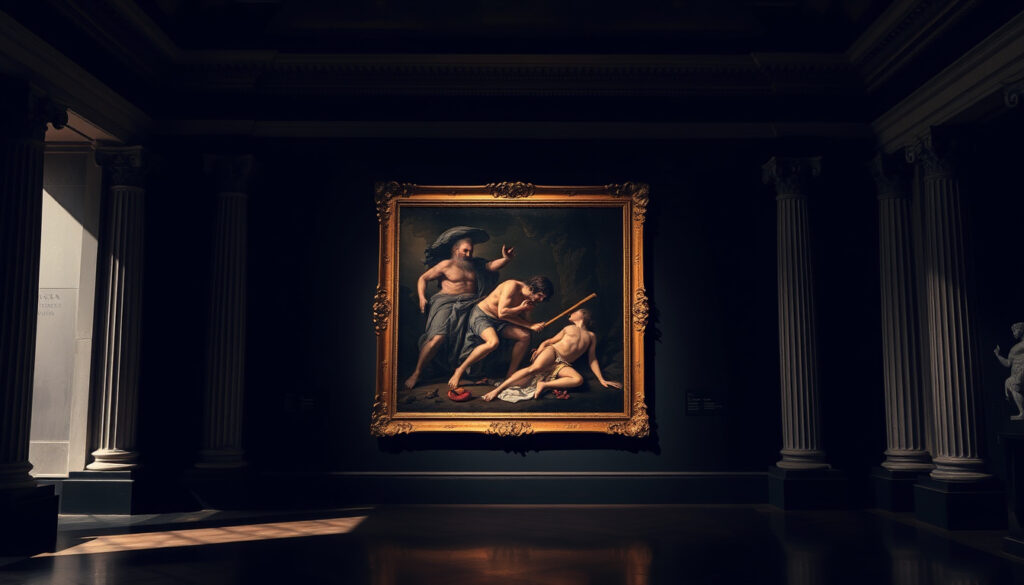
Saturn Devouring His Son: Goya’s Myth, Meaning & Location
Few paintings stop you cold the way Saturn Devouring His Son does. Francisco Goya created this image sometime between 1821 and 1823, and it still pulls viewers into a raw, unsettling place. This article walks through the Roman myth behind it, where the painting lives today at the Museo del Prado, and what scholars think Goya was really saying with those frantic eyes and bloodied hands.
Artist: Francisco Goya · Year completed: 1821–1823 · Medium: Mixed mural transferred to canvas · Dimensions: 143.5 cm × 81.4 cm · Current location: Museo Nacional del Prado, Madrid · Part of series: Black Paintings (14 works)
Quick snapshot
- Goya painted the work on the wall of his villa, Quinta del Sordo (Britannica (reference work)).
- It belongs to the Black Paintings series of 14 works (Wikipedia (community encyclopedia)).
- Now housed at the Museo Nacional del Prado in Madrid (Museo Nacional del Prado (official museum)).
- Goya’s exact intentions for the painting remain unknown (Britannica (reference work)).
- The specific child depicted is debated (some say Zeus/Jupiter) (Wikipedia (community encyclopedia)).
- The nature of Goya’s late-life mental state is speculative (Wikipedia (community encyclopedia)).
- Painted 1821–1823, after Goya’s illness and move to Quinta del Sordo. (Artnet (art news platform))
- Transferred to canvas 1874–1878, donated to Prado in 1881 (Artnet (art news platform)).
- Continued display at Prado’s Room 67, with ongoing scholarly analysis.
- Growing digital access and virtual tours of the Black Paintings.
Six key facts, one pattern: Goya turned a private wall mural into a lasting symbol of fear and time.
| Attribute | Value |
|---|---|
| Title | Saturn Devouring His Son |
| Artist | Francisco Goya y Lucientes |
| Date | 1821–1823 |
| Medium | Mixed technique on wall, later transferred to canvas |
| Dimensions | 143.5 × 81.4 cm |
| Location | Museo Nacional del Prado, Madrid (Room 67) |
Why did Saturn devour his children?
The Roman myth of Saturn and his prophecy
- In Roman mythology, Saturn (equated with the Greek Cronus) received a prophecy that one of his children would overthrow him.
- To prevent this, he swallowed each child immediately after birth (Museo Nacional del Prado (official museum label)).
Goya’s interpretation of the myth
- Goya painted the moment of consumption — the god, wild-eyed and gaunt, grips a child’s body and bites into an arm.
- The Prado describes the subject as “the Roman god Saturn eating one of his sons” (Museo Nacional del Prado (official museum)).
- The painting shows Saturn in a frenzied state, far from the dignified figure of classical art.
The implication: Goya stripped the myth of its heroic distance and forced viewers to confront the raw act.
Goya painted this not for a church or palace, but for the walls of his own home — a private act of imagination that later became a public mirror for horror.
Where is Saturn Devouring His Son now?
Location at the Museo Nacional del Prado
- The painting hangs in Room 67 of the Prado in Madrid, part of the museum’s permanent collection (Museo Nacional del Prado (official museum)).
- It is displayed alongside other Black Paintings in a dedicated room at the far southern end of the building (34th Street Magazine (university publication)).
History of the painting’s removal from Goya’s villa
- Goya painted the Black Paintings directly on the walls of his home, Quinta del Sordo (Villa of the Deaf Man), after moving there in 1819 (Britannica (reference work)).
- After his death, the paintings were transferred from plaster to canvas under the direction of Baron Émile d’Erlanger between 1874 and 1878 (Britannica (reference work)).
- The transfer process damaged the original surface; the work is now a restored canvas (Smarthistory (art history education)).
- Artnet reports the Black Paintings entered the Prado collection in 1889 (Artnet (art news platform)).
The pattern: a mural meant for a private room survived demolition, transfer, and controversy to become one of the most visited works in Madrid.
What does Goya’s Saturn symbolize?
Political interpretations
- Many scholars read the painting as a critique of time devouring all things — a memento mori for Spain’s political turmoil after the Napoleonic era (Britannica (reference work)).
- The gaunt, gray Saturn reportedly reflects Goya’s despair as Spain descended into reactionary rule.
Personal and psychological symbolism
- Goya suffered a severe illness in 1792–1793 that left him permanently deaf (Wikipedia (community encyclopedia)).
- His late works, including the Black Paintings, express deep isolation and psychological intensity.
- Some art historians suggest the painting may represent Goya’s own sense of parental failure or his fear of aging.
Artistic context of the Black Paintings
- The Black Paintings series includes 14 murals Goya created between 1819 and 1823 (Wikipedia (community encyclopedia)).
- They were not intended for public display, which gives them a raw, unfiltered quality (Britannica (reference work)).
- The paintings explore dark themes: witchcraft, violence, old age, and madness.
The catch: Goya left no written explanation. Every interpretation — political, psychological, mythological — is a guess, and that uncertainty is what keeps the painting alive.
What happened after Saturn ate his son?
The myth: eventual overthrow by Zeus
- In the myth, Saturn’s wife Ops (Rhea) saved the youngest child, Jupiter (Zeus), by tricking Saturn into swallowing a stone instead.
- Jupiter later forced Saturn to regurgitate his siblings and overthrew him (Wikipedia (community encyclopedia)).
The painting’s impact and legacy
- Goya’s painting captures only the act of devouring, not the eventual overthrow — freezing the moment of consumption forever.
- The image is widely considered one of the most disturbing in Western art (Artnet (art news platform)).
- It has appeared in countless pop-culture references, from horror films to album covers to memes.
The trade-off: Goya chose to show only the terror, not the justice — leaving viewers without the catharsis of the original myth.
The painting’s title was applied after Goya’s death (Reddit (user discussion — low confidence)). We don’t know what Goya himself called it, which adds another layer of ambiguity.
What was Goya’s mental illness?
Goya’s health decline after 1792
- In 1792–1793, Goya suffered a severe illness that resulted in permanent deafness (Wikipedia (community encyclopedia)).
- The illness may have been a form of viral encephalitis, but no definitive diagnosis exists.
Possible diagnoses and their influence on his art
- Speculative diagnoses include lead poisoning from his paints, dementia, and psychological trauma from the Napoleonic wars.
- After moving to Quinta del Sordo in 1819, Goya became increasingly isolated.
- He produced the Black Paintings during this period — works that art historian Britannica (reference work) describes as “a meditation on God’s wrath, the conflict between old age and youth, or Saturn as Time devouring all things.”
Why this matters: Goya’s deafness and isolation may have stripped away social filters, letting him paint what he truly felt — raw, uncommissioned, and utterly personal.
Timeline of Goya’s Saturn Devouring His Son
- 1746 — Francisco Goya born in Fuendetodos, Spain (Wikipedia (community encyclopedia)).
- 1792–1793 — Goya suffers severe illness, resulting in permanent deafness (Wikipedia (community encyclopedia)).
- 1819 — Goya moves into Quinta del Sordo (Villa of the Deaf Man) outside Madrid (Britannica (reference work)).
- 1821–1823 — Goya paints the Black Paintings directly on the walls of his villa, including Saturn Devouring His Son (Britannica (reference work)).
- 1874–1878 — Paintings transferred from walls to canvas under direction of Baron Émile d’Erlanger (Britannica (reference work)).
- 1881 — Donated to the Museo del Prado, Madrid (Museo Nacional del Prado (official museum)).
- Present — On display at the Museo del Prado, Room 67.
Confirmed facts and what remains unclear
Confirmed facts
- Goya painted the work in his villa between 1821 and 1823 (Britannica (reference work)).
- It belongs to the Black Paintings series (Wikipedia (community encyclopedia)).
- The subject is the myth of Saturn devouring his child (Museo Nacional del Prado (official museum)).
- The painting is now at the Prado Museum in Madrid (Museo Nacional del Prado (official museum)).
- It was originally painted on the wall of Goya’s home, Quinta del Sordo (Britannica (reference work)).
- Transfer to canvas occurred after Goya’s death (Britannica (reference work)).
What’s unclear
- Goya’s exact intentions for the painting are unknown — he left no written record (Britannica (reference work)).
- The specific child in the myth depicted is debated (some say Zeus/Jupiter, but the myth includes all siblings).
- The nature and diagnosis of Goya’s late-life mental state remain speculative (possible lead poisoning, dementia, or trauma).
- The painting’s title was assigned posthumously, so Goya’s own name for it is lost (Reddit (user discussion — low confidence)).
What critics and scholars say
Saturn Devouring His Son is “a meditation on God’s wrath, the conflict between old age and youth, or Saturn as Time devouring all things.”
— Britannica (reference work)
The Prado describes the work as “the Roman god Saturn eating one of his sons” — but notes the god’s eyes and posture convey madness rather than power.
— Museo Nacional del Prado (official museum label)
A contemporary art report describes Saturn in the painting as “gray and emaciated” rather than idealized, which strips the myth of heroic dignity.
For the viewer in Madrid — or anyone confronting this image on a screen — the implication is clear: Goya gave us a god who looks less like a ruler and more like a terrified, starving parent. The myth’s prophecy is irrelevant; the painting works because it makes you feel the act, not the story.
Art historians have long debated the psychological turmoil behind Goyas Saturn Devouring His Son which Goya painted during his final years.
Frequently asked questions about Saturn Devouring His Son
What is the Saturn Devouring His Son painting made of?
The painting was originally created using mixed technique on the plaster wall of Goya’s villa. After his death, it was transferred to canvas — a process that damaged the original surface but allowed preservation (Smarthistory (art history education)).
How large is the Saturn Devouring His Son painting?
The canvas measures 143.5 cm × 81.4 cm (about 4 ft 8 in × 2 ft 8 in) (Wikipedia (community encyclopedia)).
Is Saturn Devouring His Son a true story?
It’s based on Roman mythology — the god Saturn (Cronus) devouring his children. Goya painted the myth as a literal scene, not a historical event (Museo Nacional del Prado (official museum)).
Why is Saturn Devouring His Son called a Black Painting?
It’s part of Goya’s Black Paintings series, a set of 14 murals he painted directly on the walls of his home. The term “Black Paintings” comes from their dark themes, somber palette, and intense psychological mood (Wikipedia (community encyclopedia)).
Can I take photos of Saturn Devouring His Son at the Prado?
The Museo del Prado permits non-flash photography for personal use in most permanent collection galleries, including Room 67 where the painting hangs. Flash, tripods, and commercial photography require prior permission.
What other paintings are in Goya’s Black Paintings series?
The series includes 14 works, among them Witches’ Sabbath, Judith and Holofernes, Two Old Men Eating Soup, and The Great He-Goat (Wikipedia (community encyclopedia)).
How much is Saturn Devouring His Son worth?
The painting has never been sold and is part of the Prado’s collection. Given Goya’s stature and the work’s iconic status, its market value would be estimated in the tens of millions of euros, but it is considered priceless and inalienable under Spanish cultural heritage law.
More related posts
 Pat Benatar: Song Refusal, Ethnicity, Marriage, Net Worth & Hits
 How to Plan a Budget Trip – Step-by-Step 2025 Guide
 Justine Schofield: Relationship, Career & Latest Updates
 IKEA Display Cabinet Guide: Glass Doors, Lights & Best Models
 Pharmacies Near Me: Find the Best Local Pharmacy in Ireland
 Jared Padalecki: Biography, Height, Net Worth, and Controversies
 Joe Ingles: Career Stats, Net Worth, Family & NBL Return
 Chris Bath: Where She Lives, Farm, and Career Updates
