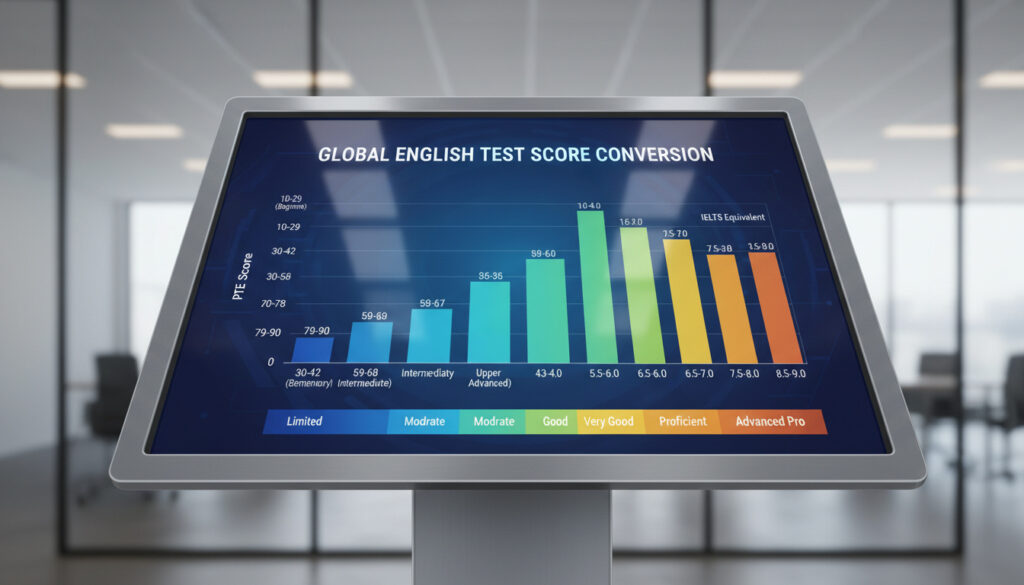
PTE Score Chart – Bands, Ranges and IELTS Equivalents
Pearson’s PTE Academic and PTE Core exams report results on a standardized scale ranging from 10 to 90. This granular system measures communicative skills—listening, reading, speaking, and writing—alongside enabling competencies such as grammar and oral fluency. Scores align with the Global Scale of English and map directly to CEFR proficiency levels from A1 through C2, providing institutions and immigration authorities with precise benchmarks for language capability.
Understanding how these numerical bands translate to practical proficiency levels remains essential for test-takers targeting university admissions or visa applications. The scoring framework utilizes AI-based assessment to minimize human bias, generating results typically within two to five business days. With over 3,300 institutions worldwide recognizing PTE credentials, including government bodies in Australia, Canada, and the United Kingdom, interpreting the score chart accurately directly impacts migration and educational outcomes.
How Does the PTE Score Chart Structure Work?
Overall Score Range
10–90 scale measuring total English proficiency
Communicative Skills
Listening, reading, speaking, writing (each 10–90)
Enabling Skills
Grammar, vocabulary, pronunciation, oral fluency (10–90)
Result Validity
Two years for immigration and university applications
The PTE scoring architecture operates on a 10-point to 90-point continuum. Each communicative skill receives an individual score within this range, while an overall score reflects aggregated performance across all sections. Enabling skills contribute to the total through specific item weightings determined by psychometric analysis.
- Scores below 30 indicate beginner (A1) proficiency with limited functional ability.
- The 59–75 range corresponds to upper-intermediate (B2) competency suitable for academic study.
- Scores of 79 and above typically satisfy “Proficient” or “Very Good” thresholds for Australian skilled migration.
- AI algorithms evaluate responses, ensuring consistent marking without human examiner variance.
- Results remain valid for 24 months from the test date for most visa and admissions purposes.
- Individual skill scores can vary by 5–10 points from the overall average, reflecting specific strengths or weaknesses.
- The scale aligns with CEFR standards, facilitating direct comparison with IELTS and other standardized tests.
| PTE Score Range | CEFR Level | Proficiency Description | IELTS Equivalent |
|---|---|---|---|
| 85–90 | C2 | Expert: Advanced fluency, outstanding command | 8.5–9.0 |
| 76–84 | C1 | Advanced: High fluency, strong accuracy | 7.0–8.0 |
| 59–75 | B2 | Upper-Intermediate: Proficient academic/professional use | 6.0–6.5 |
| 43–58 | B1 | Intermediate: Solid command, handles most situations | 5.0–5.5 |
| 30–42 | A2 | Elementary: Basic communication with difficulties | 4.0–4.5 |
| 10–29 | A1 | Beginner: Low fluency, needs significant improvement | Below 4.0 |
How Are PTE Scores Calculated and Weighted?
The overall PTE score derives from complex algorithms analyzing communicative skill performance alongside enabling skill markers. Each test item contributes partially to multiple skill scores simultaneously—a phenomenon known as cross-skill scoring. For example, a speaking task may influence both the speaking score and the reading score if it involves reading aloud.
Communicative vs. Enabling Skills
Communicative skills carry the heaviest weight in the final calculation. The system aggregates performance across twenty item types, with some tasks contributing to two skills simultaneously. Enabling skills function as supporting indicators; grammar reliability carries a coefficient of approximately 1.07, while vocabulary weighting sits near 0.93, according to Pearson’s 2024 institutional guide.
Partial Credit and Error Analysis
Unlike binary right-or-wrong systems, PTE awards partial credit for responses demonstrating partial competency. The algorithm assesses spelling accuracy, word choice appropriateness, and grammatical complexity using statistical models trained on thousands of sample responses. Human raters intervene only for coherence assessment in specific written tasks, creating a hybrid scoring approach that maintains machine efficiency while preserving qualitative judgment for high-stakes writing evaluation.
The total item score derives from up to 15 individual scoring segments per section, with raw marks converted to the 10–90 scale through equating processes that account for test difficulty variations across different administration dates.
While enabling skills like pronunciation and oral fluency appear on score reports, they serve primarily diagnostic purposes. Universities and immigration authorities generally focus on the four communicative skill scores and the overall band when making decisions.
What Are the PTE to IELTS Equivalents for Immigration?
Immigration departments, particularly in Australia, require specific concordance between PTE and IELTS scores to determine English language competence. The Australian Department of Home Affairs recognizes both PTE Academic and PTE Core for visa subclasses, though specific thresholds vary by visa category. A “Competent” English level—required for many skilled migration visas—corresponds to PTE 50 or higher overall, broadly equivalent to IELTS 6.0.
Australia Immigration Thresholds
For Australian skilled migration, visa applicants typically require minimum scores across all four communicative skills. The “Proficient” level (20 points on the points-based system) generally requires PTE 79 or above in each skill, while “Superior” status demands even higher consistency. Official concordance data from IDP IELTS indicates that an IELTS 5.5 translates to PTE Core scores of 39–46 overall, with specific skill breakdowns ranging from 40–46 in listening to 41–50 in writing.
PTE Academic vs. PTE Core Distinctions
While both tests utilize the identical 10–90 scale, PTE Core emphasizes real-life, non-academic English skills required for Canadian immigration and citizenship pathways. PTE Academic maintains its focus on university-level language proficiency. Despite sharing the numerical scale, individual task weightings differ between versions. Score reports for both versions remain accessible through the Pearson account portal indefinitely, though official validity periods restrict their use to two years from the test date for most immigration purposes as detailed in current band charts.
Specific score requirements fluctuate based on visa subclass and policy updates. While PTE 50 generally satisfies Australian “Competent” English requirements, some streams mandate higher individual skill scores or overall bands. Always verify current thresholds through official Department of Home Affairs documentation.
When Do PTE Scores Expire and How Are They Reported?
Score reports become available within two to five business days following test completion. Candidates access results through their Pearson VUE account, where they can view detailed breakdowns showing performance across all measured competencies. The digital report includes a score chart graphic illustrating where the candidate’s performance sits relative to CEFR bands and university readiness benchmarks.
Standard validity extends two years from the test date for university admissions and immigration applications. Some professional registration bodies may impose shorter validity periods or require more recent results. Institutions receiving scores electronically through the PTE secure portal can verify authenticity instantly, reducing fraud risks associated with physical certificate submissions.
How Has the PTE Scoring System Evolved?
-
Pearson launches PTE Academic, introducing the 10–90 Global Scale of English to standardized testing.
-
PTE Core enters the testing portfolio, utilizing the same scale but targeting general English proficiency for migration contexts.
-
Pearson releases updated Institution Score Guide v2, refining reliability coefficients and descriptor language based on 2021–2022 testing data detailed in the official PDF.
-
Test updates introduce real-life simulation speaking tasks and balanced mark distribution adjustments, though the 10–90 scale structure remains unchanged according to distribution analyses.
What Facts Are Definite vs. Still Developing?
Established Information
- All scores report on a fixed 10–90 scale
- CEFR alignment spans A1 through C2
- Two-year validity standard applies universally for immigration
- AI scoring underpins all assessment sections
- IELTS 6.0 equivalence falls at PTE 50+
Uncertain or Variable Information
- Exact boundary thresholds between B1/B2 bands vary slightly across published charts (e.g., 59 vs. 66 as B2 lower limit)
- Specific annual weighting adjustments for individual question types
- Future recognition of PTE Core by additional jurisdictions beyond Canada and Australia
Why Does the PTE Score Chart Matter Globally?
The PTE Score Chart 2023 – PTE Exam Scoring System & Calculation serves as the definitive reference for institutions determining applicant readiness. Universities utilize band descriptors to set minimum entry requirements—typically B2 (59–75) for undergraduate programs and C1 (76–84) for postgraduate research degrees.
For migration contexts, the granular 10–90 scale offers advantages over broader band systems. A candidate scoring 58 versus 65 receives distinct classifications, allowing immigration officers to apply precise cutoffs. This specificity extends to PTE Score Chart interpretations used by education agents and counselors when advising prospective students on necessary preparation levels.
What Do Official Sources Confirm About PTE Scoring?
Scores are reported on a scale from 10–90, with overall scores based on performance across all test items and communicative skills scores derived from specific task contributions.
Pearson PTE Academic Institution Score Guide, November 2024
For Australian immigration purposes, Competent English requires a minimum score of 50 in each of the four test components.
Australian Department of Home Affairs (via conversion tables)
What Should You Do With Your PTE Score Results?
Download your official score report immediately upon availability and verify that all four communicative skill scores meet your target institution or visa requirements. Compare your results against current Pearson scoring guidelines to identify any gaps requiring remedial work. If scores fall below necessary thresholds, analyze the enabling skills breakdown to determine whether grammar, vocabulary, or pronunciation issues contributed to lower communicative scores. Send scores to recipient institutions promptly, as processing delays can affect application deadlines.
Frequently Asked Questions
What is considered a good PTE score?
Scores between 65–79 indicate “Good” to “Very Good” English proficiency, suitable for most university admissions. For competitive programs or migration points, aim for 79+.
How long are PTE scores valid?
PTE scores remain valid for two years from the test date for university and immigration applications. Some professional bodies may require more recent results.
Can I send scores to multiple universities?
Yes. Pearson allows unlimited electronic score reports to institutions and governments at no additional cost through the online account portal.
What distinguishes PTE Academic from PTE Core scoring?
Both use the 10–90 scale, but Academic focuses on university English while Core assesses general language for migration. Task weightings differ between versions.
How soon can I retake the PTE exam?
Candidates may retake the test at any time, though booking the next available slot depends on test center availability. There is no mandatory waiting period.
Is 50 a good PTE score for Australia immigration?
A score of 50 meets the “Competent English” requirement for many Australian visas, though higher scores (65+) may provide additional migration points.
How does PTE scoring compare to IELTS?
PTE uses a 10–90 numerical scale versus IELTS 0–9 bands. Rough equivalence places IELTS 6.0 at PTE 50, IELTS 7.0 at PTE 65, and IELTS 8.0 at PTE 79.
Do universities accept PTE Core for admissions?
Most universities specifically require PTE Academic for degree programs. PTE Core targets migration and citizenship applications rather than academic admissions.
More related posts
 Mojtaba Khamenei: Biography of Iran’s New Supreme Leader
 Javier Bardem: Marriage, Accident, Children, and Career
 Harvey Norman Noosaville: Hours, Address & Catalogue
 Naomi Campbell: Children, Marriage, and Ethnicity Facts
 Shiva God: Hindu Deity of Destruction and Transformation
 Affiliate Marketing Australia: How to Start & Earn Legally
 Donna Vekic: Career, Ranking, and Relationship Status
 Sam Mitchell Guide: EastEnders, Football Coach & Sports Dad
