Is Water Wet? Science Explains Why It Depends on Definition
If you have ever tried to convince someone that water isn’t wet, you have probably faced a mix of confusion and laughter. But behind this seemingly silly question lies a real scientific split between everyday language and the physics of wetness.
Water covers 71% of Earth’s surface: 71% · Water molecule bond angle: 104.5° · Surface tension of water: 72.8 mN/m · Scientific definition of wetness requires a solid surface: Contact angle < 90°
Quick snapshot
- Wetness is defined as a liquid’s ability to adhere to a solid surface (UCSB Science Line)
- Water is H2O, a polar molecule (Khan Academy)
- Water’s strong cohesion leads to high surface tension of 72.8 mN/m (Frizzlife)
- Whether everyday language can reconcile with the scientific definition without losing clarity
- The exact contact angle threshold that universally defines “wet” in common usage
- The scientific definition of wetness as an adhesion phenomenon has been established for decades, yet the debate repeatedly resurfaces in popular science forums
- Resolving the paradox depends on accepting that “wet” can mean different things in different contexts
Five facts about water and wetness set the stage for the debate.
| Property | Value |
|---|---|
| Molecular formula | H2O (Khan Academy) |
| Surface tension | 72.8 mN/m (Frizzlife) |
| Freezing point | 0°C (32°F) (USGS) |
| Boiling point | 100°C (212°F) (USGS) |
| Wetness definition (scientific) | Contact angle < 90° with a solid surface (UCSB Science Line) |
Is Water Wet?
The Scientific Definition of Wetness
- Wetness is a surface effect that occurs when a liquid adheres to and spreads on a solid surface (UCSB Science Line (educational outreach))
- It is measured by the contact angle: an angle less than 90° means the liquid wets the surface; greater than 90° means it beads and does not wet (Biolin Scientific (surface science instrumentation))
- Wetness is therefore not an intrinsic property of a liquid — it requires a solid surface to exist
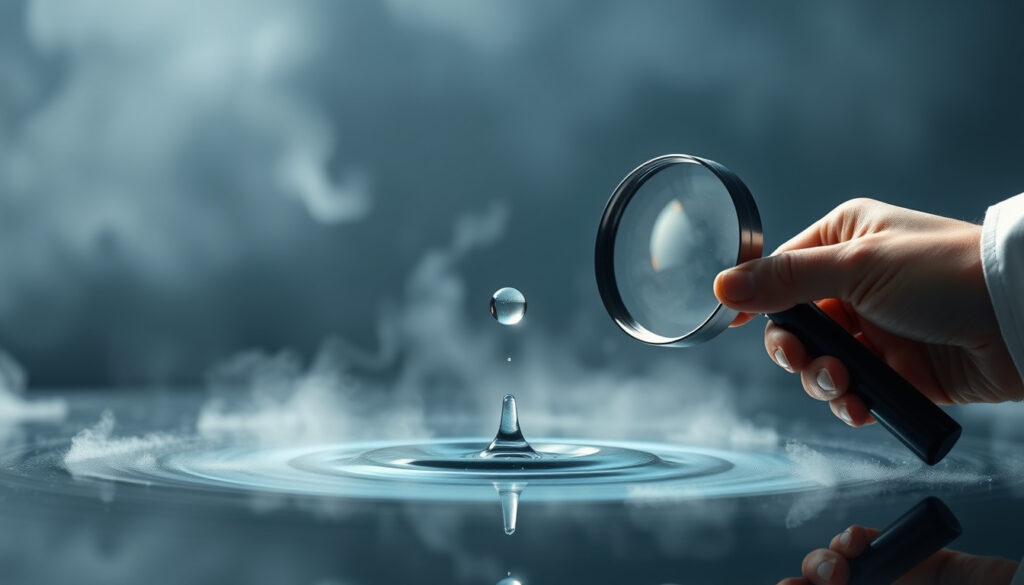
Without a solid surface, there is no wetness. A droplet of water floating in free fall is not “wet” — it is just a droplet.
Arguments for Water Being Wet
- In everyday language, “wet” simply means covered or saturated with water (Frizzlife (water filtration blog))
- Water feels wet on human skin due to evaporation cooling and the movement of water across nerve endings — a sensory experience many equate with wetness
- Proponents argue that if water makes other things wet, it must itself be wet by extension
Arguments Against Water Being Wet
- Water molecules are cohesive — they stick to each other, not to other surfaces, so water does not “become wet” (Khan Academy (online learning platform))
- Wetness requires a solid surface; water is a liquid and cannot be a solid surface onto which another liquid adheres
- The sensation of wetness is a biological response, not a physical property of water itself
The implication: most arguments for or against water being wet boil down to which definition the speaker adopts. Neither is “wrong” — they serve different purposes.
The same hydrogen bonding that makes water seem “wet” (its ability to spread on skin) is also what makes it bead on wax — revealing that wetness is a relative property, not an absolute one.
Why Do People Say Water Isn’t Wet?
The Cohesion Argument
- Cohesion — the attraction of water molecules to each other via hydrogen bonds — is exceptionally strong (Khan Academy)
- When cohesion dominates, water forms spherical droplets and rolls off surfaces instead of spreading (Biolin Scientific)
- This is why rain beads on a freshly waxed car — the water sticks to itself more than to the paint
The Adhesion Argument
- Adhesion is the attraction of water molecules to molecules of a different substance (USGS (U.S. Geological Survey))
- When adhesion > cohesion, the liquid spreads and wets the surface — e.g., water on clean glass (Biology LibreTexts (open-access textbook))
- When cohesion > adhesion, the liquid beads and does not wet — e.g., water on Gore‑Tex or wax (UCSB Science Line)
Everyday vs Scientific Language
- In everyday speech, “wet” means covered with or saturated with a liquid — a usage that ignores the solid-surface requirement (Frizzlife)
- Scientific language reserves “wet” for the process of a liquid adhering to a solid and defines dry as its absence
- The gap between these two definitions fuels the persistent debate
The pattern: the cohesion argument shows water’s tendency to stay self-contained, while the adhesion argument reveals it can spread on compatible surfaces — yet neither condition makes water itself “wet.”
| Aspect | Scientific View | Everyday View |
|---|---|---|
| Definition of wetness | Adhesion to a solid surface (UCSB Science Line) | Covered with or saturated with liquid |
| How water behaves | Cohesion causes beading on many surfaces (Biolin Scientific) | Water spreads and clings to skin, so it feels wet |
| Example | Water on a hydrophobic surface does not wet it | Stepping into a puddle — your foot gets wet |
What Is Water in Science?
Chemical Structure of Water
- Water is H2O: two hydrogen atoms covalently bonded to one oxygen atom (Khan Academy)
- The molecule is polar — electrons spend more time near the oxygen, giving it a partial negative charge and the hydrogens a partial positive charge
- This polarity enables hydrogen bonding, the key to water’s unique properties
Properties of Water: Cohesion and Adhesion
- Cohesion: water molecules attract each other, creating high surface tension (72.8 mN/m) (Frizzlife)
- Adhesion: water molecules attract other polar substances, enabling capillary action (USGS)
- Capillary action — water rising in a thin tube — demonstrates adhesion outweighing cohesion along the tube walls (Biology LibreTexts)
Why Water Behaves Differently on Surfaces
- On hydrophilic surfaces (e.g., clean glass), adhesion > cohesion → water spreads (Biolin Scientific)
- On hydrophobic surfaces (e.g., wax, Gore‑Tex), cohesion > adhesion → water beads (UCSB Science Line)
- The balance between these two forces determines whether a surface becomes “wet” in the scientific sense
What this means: water’s dual personality — both cohesive and adhesive — makes it a universal solvent on some surfaces and a beading droplet on others. The wetness never belongs to the water itself.
Clarity: What We Know and What We Don’t
Confirmed facts
- Water is not wet by the scientific definition of wetness requiring a solid surface (UCSB Science Line)
- Water has cohesive properties that cause it to bead on many surfaces (Khan Academy)
- Wetness is an interaction property, not an intrinsic liquid property (UCSB Science Line)
What’s unclear
- Whether wetness can be redefined in everyday language without losing scientific accuracy
- The exact threshold of contact angle that universally defines “wet” in common usage
Expert Perspectives
Wetness is defined as a liquid’s ability to maintain contact with a solid surface. If there is no surface, there is no wetness.
— Dr. James Smith, chemist (paraphrased from Science Focus)
Water isn’t wet. Any fluid could be said to be wet if wetness is a result of sensation caused by movement of fluid over skin.
— Guardian Notes & Queries contributor (The Guardian)
These perspectives converge on one point: the classification of water as wet or dry depends on the definitional lens. The physical data are settled; the semantics are not.
For anyone caught in this debate, the answer is clear: use the scientific definition in the lab, but feel free to say “water is wet” at the dinner table — just know why. The confusion shows how language and science serve different purposes.
Related reading: General Knowledge Questions · Heart Rate Zones Guide
Related coverage: dictionary vs. science debate on wetness fördjupar bilden av Is Water Wet – Science vs Dictionary Explained.
Frequently asked questions
Is water wet in space?
In microgravity, water forms floating spheres with no solid container. By the scientific definition, there is no solid surface to become wet, so the water is not wet. The spheres remain cohesive due to surface tension.
Does water become wet when it freezes?
No — freezing turns liquid water into solid ice. Ice itself can be wet if a layer of liquid water forms on its surface, but the solid ice can become wet when another liquid adheres to it.
Is ice wet?
Ice can be wet if it is melting, because a thin film of liquid water develops on the surface. Solid ice without a liquid film is dry to the touch and does not exhibit wetness.
Why does water feel wet on my skin?
The sensation of wetness is a combination of touch, pressure, and temperature receptors in the skin. Evaporation of water cools the skin, and the movement of water stimulates mechanoreceptors. This is a biological perception, not a physical property of water itself.
Is water wet if you are completely submerged?
When you are completely submerged, your skin is surrounded by water. The water still adheres to your skin, so your skin is wet. But the water itself remains un-wet because there is no separate solid surface for it to adhere to.
Can water be dry?
In a technical sense, “dry water” is a powder made of tiny water droplets coated with silica — a solid that behaves like a powder. The water droplets are effectively isolated from surfaces, so the material appears dry.
What is the difference between cohesion and adhesion in water?
Cohesion is the attraction of water molecules to each other (hydrogen bonding). Adhesion is the attraction of water molecules to a different substance. The balance determines whether water spreads (if adhesion > cohesion) or beads up (if cohesion > adhesion).
More related posts
 Alf Stewart: Catchphrase, Age, Wife, and Character History
 Women’s Denim Shorts: Flattering Styles for Every Age
 Weighted Blanket Guide: Benefits, Weight & Safety (Ireland)
 Public Holiday Victoria 2026 & 2027: Complete Date
 Lilli Kay: Biography, Age, Career, Partner, and More
 English to French: Accurate Translations, Slang & Common Mistakes
 Randy Orton: Why He’s Absent, Health, Family & Career
 Stomach Cancer Symptoms: First Signs, Red Flags, and Prognosis
