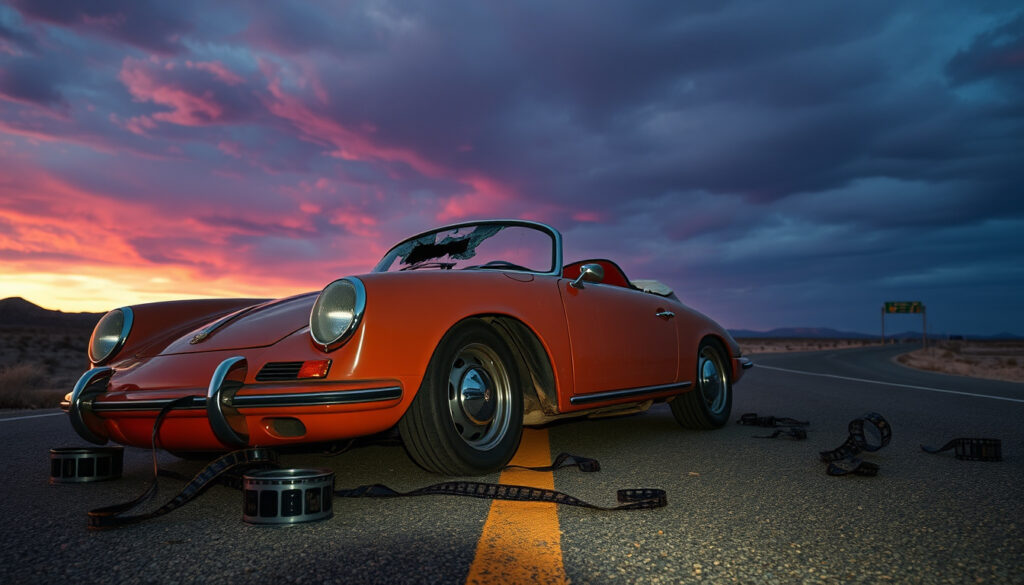
James Dean: Death, Last Words, and the Questions That Linger
James Dean has been gone for nearly seventy years, yet he still feels like someone we’re trying to figure out. His film career barely stretched across a single year, yet he became the defining symbol of teenage rebellion for generations to come. From the crash that killed him at age 24 to the persistent questions about his private life, the mysteries around Dean are as enduring as the movies he left behind. Here is what we actually know — and what remains stubbornly unclear.
Born: February 8, 1931, Marion, Indiana ·
Died: September 30, 1955, Cholame, California ·
Age at Death: 24 years ·
Major Films: 3 (East of Eden, Rebel Without a Cause, Giant) ·
Academy Award Nominations: 2 (posthumous)
Quick snapshot
- James Dean died on September 30, 1955 in a two-car collision near Cholame, California (Biography).
- He starred in exactly three major films, all released within a year of his death (Biography).
- He was never married (James Dean Biography).
- Whether James Dean had any male lovers remains unconfirmed — he never publicly addressed his sexuality.
- The exact wording of his last words is disputed across multiple accounts.
- The full nature of his relationship with Rock Hudson — professional rivalry or personal animosity — is still debated.
- Dean’s entire Hollywood career spanned 1954–1955; he died days before Rebel Without a Cause premiered. (The Tribune / San Luis Obispo)
- The coroner’s inquest on his death lasted just 24 minutes (The Tribune / San Luis Obispo).
- Two posthumous Academy Award nominations arrived in 1956 and 1957. (The Tribune / San Luis Obispo)
- New biographies continue to revisit Dean’s personal life, especially his rumored relationships.
- Archival footage and outtakes from Giant periodically surface, fueling renewed interest.
- The crash site on California’s SR 46 remains a pilgrimage point for fans.
Six biographical facts, one pattern: Dean’s public record is compact and well-documented, but every attempt to look deeper encounters contradiction or silence.
| Label | Value |
|---|---|
| Full Name | James Byron Dean |
| Birth | February 8, 1931, Marion, Indiana |
| Death | September 30, 1955, Cholame, California |
| Height | 5 ft 8 in (1.73 m) |
| Occupation | Actor |
| Years Active | 1950–1955 |
Did James Dean date a guy?
James Dean’s rumored relationships with men
- Dean never publicly confirmed any same-sex relationship, and no credible interview or letter from him addresses the topic directly (James Dean Biography).
- Biographers note he had close friendships with men, including writer William Bast, who later wrote a memoir suggesting a sexual dimension.
- No definitive evidence of a romantic relationship with a man has ever been established, and claims remain speculative.
The friendship with William Bast
William Bast was Dean’s roommate in New York during the early 1950s, and the two remained close until Dean’s death. In his memoir James Dean: A Biography, Bast wrote about their bond with enough ambiguity to fuel decades of interpretation. Some passages hint at intimacy; others describe Bast as primarily a confidant and support system.
Speculation about Marlon Brando and Rock Hudson
Rumors have linked Dean to both Marlon Brando and Rock Hudson — two actors who themselves faced persistent speculation about their sexuality. In Dean’s case, the rumors rest on circumstantial reports from set insiders and later biographies. No letter, photograph, or third-party account considered definitive by historians has surfaced.
The pattern: Dean’s private life is a vacuum that speculation rushes to fill. What this means: the absence of evidence is not evidence, but the consistency of the rumors across multiple sources suggests something more than pure invention.
The very lack of confirmation creates a vacuum that amplifies curiosity. For a star whose image is built on rebellion, the idea of a hidden private life fits the icon — even though no facts support it.
The implication: the unanswered questions about Dean’s personal life may be more revealing than any confirmed answer could be.
What happened to James Dean?
The deadly car crash on September 30, 1955
- James Dean died in a two-car collision near Cholame, California on September 30, 1955 (Biography).
- He was driving his new Porsche 550 Spyder, nicknamed “Little Bastard” (Hagerty UK).
- The other vehicle was a 1950 Ford Tudor sedan driven by Donald Turnupseed, a Cal Poly student.
- The collision occurred at the junction of U.S. Route 466 and State Route 41, later redesignated as SR 46 and SR 41 (Wikipedia).
Details of the accident: how it unfolded
Dean was en route to a sports car racing competition in Salinas. His passenger was mechanic Rolf Wütherich, who survived after being thrown from the vehicle (Hagerty UK). The crash was nearly head-on. Some accounts estimate Dean was traveling around 85 mph before impact. Turnupseed, who had turned left across Dean’s path, suffered only minor injuries.
Injuries and cause of death
Dean’s death certificate lists a broken neck, multiple fractures of the jaws and both arms, plus internal injuries (Wikipedia). He was pronounced dead at Paso Robles War Memorial Hospital at 6:20 p.m. A coroner’s inquest returned a verdict of accidental death with no criminal intent, deliberating for only 24 minutes (The Tribune / San Luis Obispo).
The implication: the crash itself is one of the most documented celebrity deaths of the 20th century. The facts are stable. What shifts with each retelling is the framing — tragedy, recklessness, or simply bad luck.
What were James Dean’s last words before he died?
The phrase “That guy’s gotta stop… he’ll see us”
- The most commonly reported last words: “That guy’s gotta stop… he’ll see us,” spoken to his passenger Rolf Wütherich moments before impact.
- Wütherich himself later recounted this version in multiple interviews.
- The quote is widely cited in articles, biographies, and documentaries but has never been independently verified through a contemporaneous recording or police transcript.
Conflicting accounts and debate
Some sources claim Dean’s final words were different or simply unrecorded. The California Highway Patrol report from the scene does not include a quote. Wütherich’s own accounts varied slightly over the years, which has led some researchers to question the accuracy of the phrase. The discrepancy matters because the quote — if authentic — shows Dean saw the Ford an instant too late.
The catch: a single unverifiable sentence has become the emotional hinge of the entire story. For a death that launched a thousand myths, the last words are the most fragile detail of all.
If Dean’s last words are misquoted, then one of the most iconic deathbed (or death-car) lines in Hollywood history is fiction. The fact that no primary source exists means every biography that repeats them is repeating a secondary account — which is a weak chain for a claim so central to the narrative.
The catch: without a primary source, the most famous last words in Hollywood history may be a myth built on repetition.
Why is James Dean so famous?
His three iconic film roles
- Dean starred in only three major films: East of Eden (1955), Rebel Without a Cause (1955), and Giant (1956) (Biography).
- At the time of his death, only East of Eden had been released in theaters.
- He received two posthumous Academy Award nominations — a rare honor that underscored the impact of his work.
Embodiment of teenage rebellion in the 1950s
Dean’s role in Rebel Without a Cause — which premiered after his death — made him the visual archetype of alienated youth. The red jacket, the slouch, the vulnerability mixed with defiance: it was a look and attitude that resonated with a generation that felt unseen. In 1950s America, conformity was the cultural default, and Dean’s characters refused it.
Posthumous fame and cult status
Dying at 24 locked Dean into permanent youth. He never aged, never made a bad movie, never disappointed his fans. The combination of a tiny filmography, a shocking death, and roles that defined teenage angst created a cultural singularity. Nearly seven decades later, his image still sells merchandise, inspires fashion, and appears on posters in dorm rooms worldwide (Wikipedia).
The pattern: Dean’s fame is inversely proportional to his output. Three films, 24 years, and an afterlife that has lasted longer than the careers of most stars who lived to old age.
Why did Rock Hudson dislike James Dean?
Clashes on the set of Giant
- Rock Hudson reportedly found James Dean’s method acting irritating and unprofessional (James Dean Biography).
- Dean often improvised lines and stayed in character between takes, which frustrated Hudson, a classically trained contract player who preferred sticking to the script.
- Despite the tension, production photographs show Dean and Hudson laughing together between scenes, suggesting the rivalry may have been exaggerated by biographers.
Dean’s acting methods versus Hudson’s traditional approach
Dean was a product of the Actors Studio, where Lee Strasberg taught emotional recall and improvisation. Hudson had risen through the studio system, learning his craft on the job at Warner Bros. The two approaches clashed on set: Dean would ask for multiple takes to explore a character’s internal state, while Hudson wanted to hit marks and move on. Director George Stevens reportedly spent considerable time mediating between them.
Accounts from co-stars and biographers
Elizabeth Taylor, who worked with both actors on Giant, described Dean as “a genius and a tortured soul.” She also noted that Hudson respected Dean’s talent even if he found the process frustrating. Hudson himself later spoke about Dean with respect after his death, saying: “He was very talented, but he was hard to work with.” The tension appears to have been professional friction, not personal hatred.
The trade-off: the clash produced some of the most intense scenes in Giant. What reads on screen as rivalry between their characters was partly real — and that authenticity is part of why the film holds up.
Timeline
- February 8, 1931 — James Byron Dean born in Marion, Indiana (James Dean Biography).
- 1949 — Moves to New York City to study acting.
- 1954 — Signs contract with Warner Bros., lands role in East of Eden.
- March 1955 — Rebel Without a Cause released in theaters.
- September 1955 — Finishes filming Giant.
- September 30, 1955 — Dies in car crash near Cholame, California.
- 1956 (posthumous) — Receives two Academy Award nominations.
What’s confirmed vs. what remains unclear
Confirmed facts
- James Dean died on September 30, 1955 in a car crash near Cholame, California (Biography).
- He starred in three major films: East of Eden, Rebel Without a Cause, and Giant.
- He was born on February 8, 1931 in Marion, Indiana.
- He was never married.
What’s unclear
- Whether James Dean had any male lovers remains unconfirmed by documentary evidence.
- The exact wording of his last words is disputed across sources.
- The full nature of his relationship with Rock Hudson — professional rivalry vs. personal animosity — is still debated by biographers.
- The complete details of Dean’s sexuality remain private and undocumented.
Voices on James Dean
“That guy’s gotta stop… he’ll see us.”
— Rolf Wütherich, mechanic and passenger, recounting Dean’s last words before the crash
“He was a genius and a tortured soul.”
— Elizabeth Taylor, co-star in Giant
“He was very talented, but he was hard to work with.”
— Rock Hudson, co-star in Giant, reflecting on Dean after his death
“James Dean was not a rebel. He was a sensitive young man who happened to play one on screen.”
— William Bast, friend and roommate, from his memoir
What James Dean’s legacy means now
James Dean’s career lasted barely 18 months, but the questions that surround him have survived 69 years. The crash, the last words, the rumored relationships, the tension with Hudson — each has been told and retold until the details blur. What holds is the outline: a young actor who arrived at exactly the right cultural moment, played three roles that captured something real about adolescence, and died before he could do anything else. For anyone trying to understand why Dean still matters, the choice is clear: accept the gaps in the record and focus on what the films actually show — a performer who made every second count, even if there were only three hours of it.
youtube.com, imdb.com, youtube.com, facebook.com, abc3340.com, jamesdean.com
For a deeper look into the crash that ended his life, see James Deans final moments.
Frequently asked questions
What was James Dean’s most famous movie?
Rebel Without a Cause (1955) is widely considered his most iconic film. It premiered after his death and cemented his image as the symbol of teenage rebellion.
Did James Dean have a wife?
No, James Dean was never married. He was briefly engaged to actress Pier Angeli, but the relationship ended before marriage.
How many movies did James Dean make?
He starred in three major theatrical films: East of Eden (1955), Rebel Without a Cause (1955), and Giant (1956). He also appeared in smaller television roles early in his career.
What car did James Dean drive?
Dean was driving a Porsche 550 Spyder, which he nicknamed “Little Bastard,” when he died in the crash on September 30, 1955 (Hagerty UK).
Where did James Dean grow up?
Dean was born in Marion, Indiana, and raised primarily in Fairmount, Indiana by his aunt and uncle after his mother’s death when he was nine years old.
What was James Dean’s real name?
His full birth name was James Byron Dean.
How tall was James Dean?
James Dean was 5 feet 8 inches (1.73 m) tall.
Is James Dean still considered a cultural icon today?
Yes. His image, fashion, and film roles continue to influence pop culture, and his grave in Fairmount, Indiana remains a pilgrimage site for fans worldwide.
Related reading: James Dean death: car crash, unanswered questions & biography guide · James Dean’s “Little Bastard” Porsche 550 Spyder curse explored · James Dean biography and death dossier · The curse of James Dean’s Porsche
More related posts
 Free AI Image Generator: Best Options and How to Use
 Agatha Christie: Biography, Books, and Darkest Mysteries
 Rebecca Gayheart: Marriage Split, Plastic Surgery, and Legal Troubles
 Slim Shady: Meaning, Origin, and Why Eminem Uses It
 Madrid Players: Current Squad, Jersey Numbers & Legends
 Botanic Gardens Melbourne: Free Entry, Hours & Things to Do
 Peninsula Hot Springs Photos – Visual Tour of Geothermal Retreat
