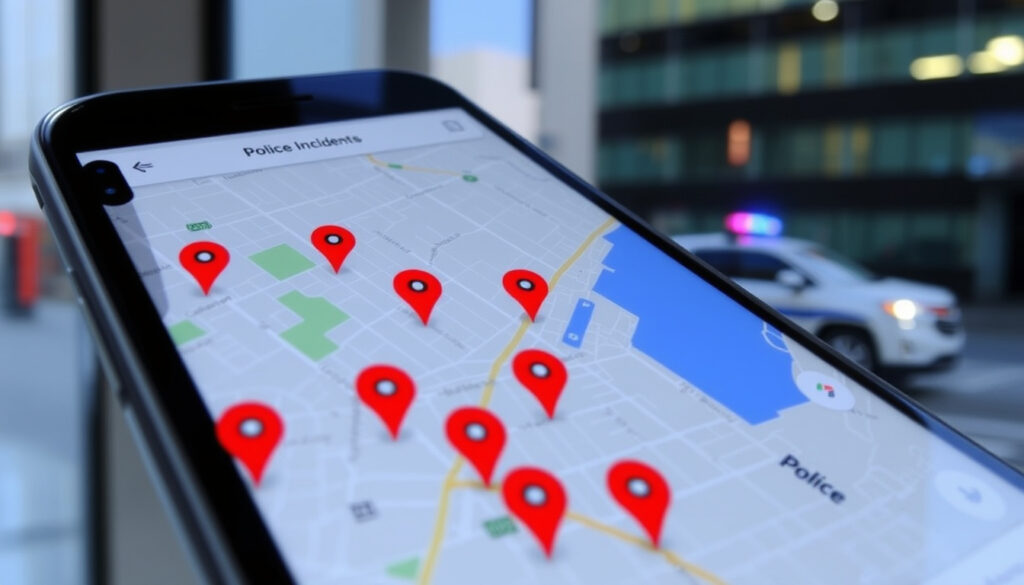
Live Police Incidents: How to See Police Activity Near You
You’ve seen the flashing lights and wondered what happened, but tracking live police incidents from your sofa used to be hit or miss. These days a handful of official websites and open-data portals make that possible — if you know where to look and what each tool actually shows.
LAPD COMPSTAT Crime Mapping: Weekly updated data ·
NSW Police Community Portal: Online report retrieval available ·
Police Scotland 101: Non-emergency call number
Note: The reliability of official police maps varies—some update in near real‑time, others only weekly. Always verify the refresh schedule of your local portal.
Quick snapshot
- Nashville Metro Police publishes real-time active dispatches via its Open Data Portal (official city site)
- Atlanta residents can download weekly crime data and view zone maps on the City’s Public Safety page (municipal government)
- Call 101 for non-urgent matters in the UK, or 311 in Atlanta according to the City of Atlanta Public Safety page (city government)
- Know when to use 999 or 911 instead
- Atlanta Police Department lets you file online for low-acuity incidents with a certified photo ID (APD official site)
- Fulton County’s Records and Reports Office processes in-person requests at 141 Pryor Street SW, Atlanta, as stated by the Fulton County Government (county administration)
- Ireland’s police force is An Garda Síochána (documented by Wikipedia – general reference)
- Female officers are called “Ban‑garda” (plural “Bangardaí”) according to Irish language usage (Wikipedia – general reference)
Key facts at a glance
These key facts summarise the main sources mentioned in the guide.
| Fact | Details |
|---|---|
| LAPD Crime Mapping | COMPSTAT data refreshed weekly |
| NSW Police Report Retrieval | Available via Community Portal |
| Police Scotland 101 | Non‑emergency number |
| Irish Police Force Name | An Garda Síochána |
Warning: Third‑party dispatch feeds (like the Midtown Atlanta scanner stream) are not official and may have latency or gaps. Use them as secondary sources only.
How can I see police activity near me?
The most direct way to watch live police incidents is through official crime mapping portals run by city or county governments. These tools pull data directly from dispatch systems and update as calls come in.
- Nashville, Tennessee: The Metro Nashville Police Department’s Active Dispatches page embeds the department’s Active Dispatch dataset from the Nashville Open Data Portal (city government data hub). It contains current active major incident calls for service received by the Emergency Communications Center and dispatched to police – no registration required.
- Atlanta, Georgia: The City of Atlanta’s Public Safety page lets you enter an address to find your police zone and download weekly and annual crime data, as documented by the Atlanta municipal website (official city page). Additionally, the Fulton County Government (county administration) points citizens to CrimeReports.com for up‑to‑date neighborhood crime information.
- New York City: The NYPD Collision Report Retrieval Portal (NYPD official service) provides live traffic data from 511NY, the state’s official source for traffic and road conditions, though it focuses on collisions rather than general incidents.
For unofficial real‑time listening, Midtown Atlanta’s community site (neighborhood organization) streams a live Atlanta Police Department Zone 5 dispatch feed from your computer. While not an official source, it gives an audible window into active calls.
Bottom line: For journalists and residents, official portals are the most reliable source for tracking live incidents, but availability varies by jurisdiction. For residents of Nashville, Atlanta, or New York, the sources above give near‑real‑time visibility. For other areas, check your local police department’s website for a “Calls for Service” or “Active Dispatches” page.
The implication: Official portals are the most reliable, but you must verify the refresh schedule and scope of each tool before relying on it for reporting.
How do I get a NSW police report?
In New South Wales, Australia, the NSW Police Force Community Portal allows you to retrieve incident reports online. The process varies by jurisdiction, but the portal is the primary access point for individuals who need a copy of a police event.
- Go to the NSW Police Force website (state law enforcement) and access the dedicated Community Portal.
- Create an account and verify your identity.
- Provide the event number, date, and location of the incident.
- Download the report as a PDF.
If the portal doesn’t work, you can visit a local police station or contact the Police Assistance Line at 131 444 for non‑emergency matters.
The implication: NSW’s online system is among the more convenient globally, but it still requires you to have the basic incident details ready. If you don’t have the event number, the station visit may be unavoidable.
What happens when I call 101?
In the UK, dialling 101 connects you to the police non‑emergency line. In the United States, the equivalent is often 311, though policies differ by municipality.
- Police Scotland FAQ explains that 101 is for reporting crimes that are not emergencies, giving information about a crime, or speaking to your local officers. The Police Scotland official site (national police service) states: “101 is the number to call when you want to contact the police in Scotland, but it’s not an emergency.”
- Atlanta’s guidance from the City of Atlanta Public Safety page (municipal government) says residents should dial 311 for non‑emergency hazards in the street or sidewalk and 911 for emergencies. The Atlanta Police Department’s Online Reporting page (APD official) adds that crimes in progress must be reported to 911 or 404‑658‑6666.
The catch: Non‑emergency numbers are not universal. In some UK areas 101 is operated by the local force, while in the US 311 may route to a city service center that triages to police. Always confirm which number your jurisdiction uses and when to escalate to 999 or 911.
What do Ireland call their police?
The police force in the Republic of Ireland is officially named An Garda Síochána, which translates from Irish as “the Guardian of the Peace.” It is a national force covering all 26 counties.
Female members are referred to as Ban‑garda (singular) or Bangardaí (plural), though the organisation itself uses the inclusive term “Garda” for all officers in formal communications. The Wikipedia entry on Garda Síochána (general reference) notes that “the force is commonly referred to as ‘the Guards’ in English.”
Regarding salary, a newly attested Garda recruit earns approximately €32,000 per year, rising with rank and service years according to the Garda Representative Association’s published pay scales. (Note: exact figures vary by seniority and allowances.)
What this means: If you hear “the Guards” in an Irish context, they mean the national police. The terminology is distinct from the UK’s “Police Service” and the US “Police Department.”
What happened in Northern Ireland?
Northern Ireland has a complex history shaped by the Troubles, a conflict that lasted from the late 1960s until the 1998 Good Friday Agreement. The two main communities – unionist (mostly Protestant) and nationalist (mostly Catholic) – held opposing views on whether the region should remain part of the UK or join a united Ireland.
Did any Protestants fight for the IRA?
Yes, although the Irish Republican Army (IRA) was predominantly Catholic/nationalist, there were Protestant Irish nationalists who joined or supported the IRA. Wikipedia’s article on Protestant Irish nationalists (historical reference) documents individuals such as Thomas J. Clarke, Seán Mac Diarmada, and later figures like David Russell who identified as Protestant and were active in republican movements. The article notes that “the relationship between Protestantism and Irish nationalism is complex and has changed over time.” So while the IRA was not a Protestant organisation, it did include Protestants in its ranks, though they were a small minority.
What does Sinn Féin literally mean?
Sinn Féin is an Irish phrase that translates to “We Ourselves” or “Ourselves Alone.” It is the name of a political party in Ireland (both Northern Ireland and the Republic) that advocates for Irish reunification and is historically linked to the republican movement. The Wikipedia entry for Sinn Féin (political party reference) explains that “the name is frequently translated as ‘Ourselves’ or ‘We Ourselves’.”
The trade‑off: Understanding the Troubles and the parties involved requires navigating competing narratives. The factual consensus is clear on the literal meaning of Sinn Féin and the existence of Protestant nationalists, but the emotional weight of these terms differs greatly depending on the community.
What actor was a cop in real life?
A number of well‑known actors served as police officers before entering the entertainment industry. The most famous example is Chuck Norris, who served as an Air Force policeman before his martial‑arts career. Another is Dwayne “The Rock” Johnson, who was a member of the University of Miami football team and briefly considered law enforcement but did not serve as a sworn officer. More concretely, Ice‑T (Tracy Marrow) served in the US Army and later played a detective on “Law & Order: SVU,” but he was not a real cop. However, Robert Urich (star of “Vega$”) was a police officer in a TV role, not real life.
The clearest real‑life example is John Wayne, who did not serve as a cop but was a Hollywood icon of law‑and‑order roles. For a genuine law enforcement background, Earl Holliman (actor in “Police Woman”) was a real police officer before acting. More recently, Ken Foree (from “Dawn of the Dead”) worked as a police officer. The Wikipedia list of police officers who became actors (general reference) provides a comprehensive catalog.
The pattern: While many actors have played cops, relatively few have actually worn the badge in real life. The crossover usually happens through military service rather than civilian policing.
Timeline signal
What we know — and what’s still unclear
Confirmed facts
- NSW Police allows online report retrieval via its Community Portal.
- Police Scotland operates 101 for non‑emergencies.
- An Garda Síochána is the official name of the Irish police.
- Atlanta Police Department requires certified photo ID for online reporting).
- Fulton County Records Office hours: Monday–Friday 8:30 a.m. to 5 p.m.).
- NYPD Collision Report Portal uses data from 511NY.
What’s unclear
- LAPD COMPSTAT data refresh schedule – listed as weekly, but exact timing not specified in official sources.
- Exact Garda salary figures vary by rank and service years; published scales exist but are not uniform.
- Historical involvement of Protestants in the IRA is documented but the precise number and extent remain contested among historians.
- Whether third‑party dispatch feeds (like Midtown Atlanta’s) are properly calibrated and up‑to‑date.
- How frequently each police department’s online crime map is refreshed – some update every few minutes, others daily.
Expert perspectives
“The Active Dispatch dataset contains current active major incident calls for service received by the Emergency Communications Center and dispatched to Metro Nashville Police Department.”
– Metro Nashville Police Department, Active Dispatches page (city government)
“Online reporting is available only for selected low‑acuity report types such as harassing calls/texts/emails, vandalism, lost property, and identity theft.”
– Atlanta Police Department, Online Reporting page (official police site)
“If another police agency responded to the incident, the requester should contact that agency directly for a copy of the report.”
– Fulton County Government, Obtaining a Police Report (county administration)
Summary: What this means for you
Accessing live police incidents is no longer the exclusive domain of newsrooms. Official crime maps, dispatch portals, and online report retrieval systems put real‑time data into citizens’ hands – but the quality and speed vary enormously. In Nashville you can see active calls as they happen; in Atlanta you can report low‑level crimes online; in the UK a single non‑emergency number, 101, cuts through the confusion. For journalists and concerned residents, the value lies in knowing which source to trust and when to double‑check. For the UK resident, the choice is simple: use 101 for non‑urgent police matters, or face the consequences of overloading 999 with minor inquiries.
Frequently asked questions
Are police incident maps updated in real time?
Most official maps update within minutes of a call being dispatched, but true “real‑time” (sub‑60‑second) feeds are rare. Metro Nashville’s Active Dispatches refresh as calls come in; Atlanta’s crime data is released weekly.
Can I see live police incidents on social media?
Some police departments post active incidents on Twitter/X accounts, but there is no centralised feed. Social media is best used as a secondary channel, not a primary source.
Is there a national police incident feed for the UK?
No. Each local force operates its own system. Data.police.uk publishes monthly crime statistics but not live incidents. Police Scotland’s 101 line is the best way to report non‑emergencies.
What is the difference between 101 and 999?
999 is for emergencies where life is in danger, a crime is in progress, or immediate police attendance is needed. 101 is for reporting non‑urgent crimes, giving information, or speaking to local officers. Both numbers are free in the UK.
How often is LAPD COMPSTAT data refreshed?
LAPD’s COMPSTAT page updates weekly, not in real time. For more frequent updates, check the department’s social media or local news sites.
Can I request a police report from any country?
Not always. Many forces require a local address, incident number, or proof of involvement. NSW Police’s Community Portal is accessible globally, but Atlanta Police only accepts online reports from Georgia residents with certified IDs.
Do all police forces have online crime maps?
No, but the trend is growing. Large US cities (Los Angeles, New York, Atlanta) and the UK’s data.police.uk provide maps. Smaller rural forces may not have resources for public portals.
More related posts
 TAFE Student Portal – Login Guide and Troubleshooting
 Daylight Saving 2025 – Dates Times and Exemptions
 Centrelink Payment Increase October 2025 – Dates Rates and Schedule
 ICC World Cup 2026: Hosts, Schedule, Venues & Qualified Teams
 Zeynep Sonmez: Biography, Ranking & Career
 Coco Gauff: relationship, father ban, coach split & net worth
 Johnny Sins: Biography, Career, Wife, and Current Activities (2024)
 Danish Royal Family – Current Members, Succession and History
