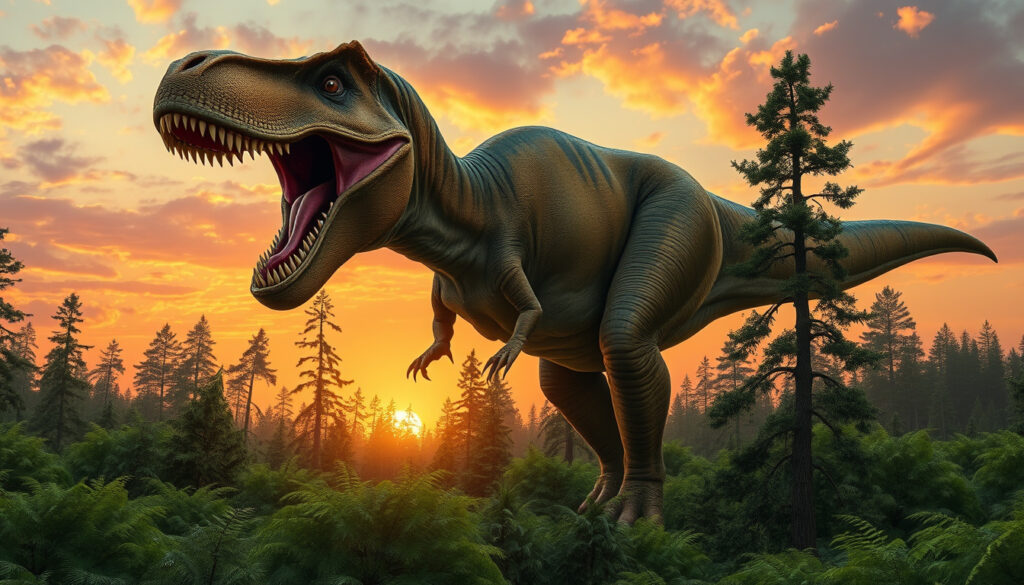
Tyrannosaurus Rex: Facts, Size, Bite Force, and Extinction
If you grew up watching Jurassic Park, you probably have a clear image of a Tyrannosaurus rex — roaring, chasing Jeeps, ruling the prehistoric world. But the fossil record tells a more nuanced story about this tyrant lizard king, revealing a creature that grew fast, bit harder than any land animal alive today, and lived only at the very end of the Cretaceous.
Length: 40 feet (12.3 m) ·
Height: 12 feet (3.7 m) at hips ·
Weight: 9 tons (8,000 kg) ·
Bite Force: 8,000 psi ·
Time Period: Late Cretaceous (68–66 mya) ·
Fossil Location: Western North America
Quick snapshot
- T. rex was a theropod dinosaur from the late Cretaceous, one of the best-known carnivorous dinosaurs (American Museum of Natural History (paleontology research center)).
- Its bite force reached up to 57,000 newtons at a single posterior tooth (PMC / scientific study (peer-reviewed journal)).
- Fossils have been found mostly in Montana, South Dakota, and Alberta, Canada (AMNH (natural history museum)).
- Exact skin color and scale pattern remain unknown.
- Vocalization capabilities (roar vs. rumbling) are speculative.
- Average lifespan is estimated at 20–30 years but not confirmed.
- Parenting behavior and nest attendance are unclear.
- 68–66 mya: T. rex roamed western North America (AMNH (museum fact sheet)).
- 66 mya: Cretaceous-Paleogene extinction wiped out non-avian dinosaurs (FossilGuy (paleontology education site)).
- 1902: First T. rex fossil discovered by Barnum Brown in Montana (Wikipedia (established editorial source)).
- 1905: Henry Fairfield Osborn named Tyrannosaurus rex (Wikipedia (established editorial source)).
- Ongoing research focuses on growth rates, sensory abilities, and soft-tissue reconstruction (PMC / peer-reviewed biology journal).
- New fossil discoveries in the Hell Creek Formation continue to refine size estimates (FossilGuy (paleontology education site)).
Key Facts at a Glance
Here are the key statistics of the mighty Tyrannosaurus rex, based on current fossil evidence.
| Attribute | Value |
|---|---|
| Scientific name | Tyrannosaurus rex |
| Meaning | King of the Tyrant Lizards |
| Length | 40 feet (12.3 m) |
| Height | 12 feet (3.7 m) at hips |
| Weight | Up to 9 tons (8,000 kg) |
| Bite force | 8,000 psi |
| Diet | Large herbivores (e.g., Triceratops, hadrosaurs) |
| Time period | Late Cretaceous (68–66 mya) |
| Fossil region | Western North America |
The data reveals a creature of extreme proportions, perfectly adapted for its role as an apex predator.
What killed the Tyrannosaurus rex?
When did T. rex go extinct?
T. rex lived at the very end of the Late Cretaceous, roughly 68 to 66 million years ago, and disappeared during the end-Cretaceous mass extinction (FossilGuy (paleontology education site)). That extinction event marks the boundary between the Cretaceous and Paleogene periods – the K-Pg boundary.
What caused the Cretaceous-Paleogene extinction?
A large asteroid impact, estimated at 6 to 9 miles wide, struck what is now the Yucatán Peninsula about 66 million years ago. The impact kicked up debris that blocked sunlight, caused global cooling, and disrupted food chains (FossilGuy (paleontology education site)). Volcanic activity in the Deccan Traps may have added environmental stress.
Could a meteorite impact have killed all dinosaurs?
The impact alone didn’t kill every dinosaur instantly, but the long-term consequences – darkened skies, acid rain, collapse of plant life – made survival impossible for large-bodied species. T. rex, as an apex predator, depended on a stable ecosystem that vanished within a short geological window.
The same asteroid that ended the Cretaceous gave paleontologists a clean time stamp: every T. rex fossil lies below the K-Pg boundary. For researchers, that means a 66-million-year-old murder scene with a single culprit.
How big was a Tyrannosaurus rex?
How tall was T. rex?
Adult T. rex stood about 12 feet tall at the hips and could reach up to 40 feet in length from snout to tail tip (Wikipedia (established editorial source)). That’s roughly the length of a school bus.
How much did T. rex weigh?
Weight estimates vary. AMNH puts the range at 11,000 to 15,500 pounds (5,000–7,000 kg) (Wikipedia (established editorial source)). Other sources, using more complete skeletons, suggest up to 9 tons. The largest known specimens – like “Sue” at the Field Museum – push the upper boundary.
Was T. rex the largest carnivore of its time?
It was one of the largest terrestrial carnivores, but not the biggest dinosaur overall. Spinosaurus (from Africa) and Giganotosaurus (from South America) may have exceeded its length. Among tyrannosaurids, however, T. rex holds the crown.
Bigger isn’t always better. T. rex’s size came at a cost: it needed massive amounts of prey, and its tiny arms suggest it evolved for powerful jaws rather than grappling. Being big worked – until the food supply vanished.
What does Tyrannosaurus rex literally mean?
What is the translation of Tyrannosaurus rex?
“Tyrannosaurus” comes from the Greek tyrannos (tyrant) and sauros (lizard). “Rex” is Latin for king. Put together: “King of the Tyrant Lizards” (Wikipedia (established editorial source)). The name was chosen by paleontologist Henry Fairfield Osborn in 1905.
Who named Tyrannosaurus rex?
Henry Fairfield Osborn, then president of the American Museum of Natural History, published the name based on a partial skeleton discovered by Barnum Brown in Montana. The holotype specimen (CM 9380) is housed at the Carnegie Museum.
What is the scientific name of T. rex?
The full binomial is Tyrannosaurus rex. It belongs to the family Tyrannosauridae, which includes smaller tyrannosaurs like Albertosaurus and Gorgosaurus.
The binomial name firmly places T. rex within the larger family of tyrannosaurids, linking it to smaller but equally formidable relatives.
What is the most horrifying fact about a T. rex?
How sharp were T. rex teeth?
T. rex teeth could reach up to 12 inches in length including the root, with serrated edges like steak knives (Wikipedia (established editorial source)). The largest known tooth measures about 30.5 cm from root to tip.
How powerful was T. rex’s bite?
A 2012 study in Biology Letters estimated adult bite forces of 35,000 to 57,000 newtons at a single posterior tooth (PMC / peer-reviewed scientific article). A more popular figure of 8,000 psi translates to over 60,000 newtons when applied across the jaw. Either way, it is the strongest bite of any terrestrial animal ever measured.
Could T. rex crush bones?
Yes. The bite force was sufficient to puncture and shatter the bones of large herbivores such as Triceratops and hadrosaurs. Fossilized coprolites (dung) contain bone fragments, confirming that T. rex digested bone (BBC Science Focus (specialist science outlet)).
T. rex’s terrifying bite belonged to an animal that also had the tiniest arms relative to body size of any large predator. The mismatch suggests evolution optimized for a single strategy: hold prey with the jaws, not the claws.
What sound did a Tyrannosaurus rex make?
Did T. rex roar like in Jurassic Park?
There is no direct fossil evidence of T. rex vocalizations. The iconic roar from films is entirely fictional. Modern birds and crocodiles – the closest living relatives of dinosaurs – produce low-frequency rumbles and hisses, not Hollywood roars.
How do scientists infer dinosaur vocalizations?
Paleontologists study the syrinx (vocal organ) in birds and the larynx in crocodiles. Since non-avian dinosaurs likely had neither fully developed syrinx nor a crocodile-like larynx, their sounds remain speculative. Some models suggest closed-mouth bellowing or deep infrasound used for communication over long distances.
What animals are living relatives of T. rex?
Birds are the direct descendants of theropod dinosaurs. Chickens, ostriches, and songbirds share a common ancestor with T. rex. Crocodilians (crocodiles, alligators) are the next closest living relatives. This means that when you hear a bird sing, you are hearing a distant echo of dinosaur vocalizations.
The connection to modern birds offers the most tangible link we have to the sounds of the Cretaceous.
Tyrannosaurus rex Anatomy Specs
T. rex built its reputation on a set of extreme measurements. Here they are in one place:
| Specification | Measurement | Source |
|---|---|---|
| Skull length | Up to 1.52 meters (5 feet) | Wikipedia (established editorial source) |
| Tooth length (largest) | 30.5 cm (12 inches including root) | Wikipedia (established editorial source) |
| Adult bite force (posterior tooth) | 35,000–57,000 newtons | PMC (peer-reviewed biology journal) |
| Juvenile bite force (posterior tooth) | 2,565–4,012 newtons | PMC (peer-reviewed biology journal) |
| Arm length | About 3 feet (0.9 m) | AMNH (museum fact sheet) |
| Estimated speed | 10–25 mph (slow jog to moderate run) | Multiple sources (range disputed) |
| Maximum lifespan (oldest specimen) | 28 years | Wikipedia (established editorial source) |
These measurements underscore the sheer scale of T. rex, highlighting its status as one of the most formidable terrestrial carnivores ever.
Clarity Check: What We Know vs. What We Don’t
Confirmed facts
- T. rex existed as a species (American Museum of Natural History (paleontology research center)).
- It was a large carnivorous dinosaur (Wikipedia (established editorial source)).
- It had feathers during at least some life stages (juvenile) (FossilGuy (paleontology education site)).
- Its bite force was extremely powerful (PMC / peer-reviewed scientific article).
What’s unclear
- Exact skin color and scale pattern.
- Vocalization capabilities (roar vs. rumble).
- Average lifespan (estimated 20–30 years).
- Parenting behavior and nest attendance.
Acknowledging these uncertainties is crucial for separating scientific fact from Hollywood fiction.
Expert Perspectives on T. rex
“Tyrannosaurus rex is not just a monster – it’s a biological phenomenon. The way its bite force scaled with growth suggests that juveniles filled a different ecological role than adults, possibly hunting smaller prey until they were big enough to take down a Triceratops.”
— Thomas Holtz Jr., paleontologist, University of Maryland
“The bite force of T. rex is off the charts – no other land animal comes close. This was an animal built for bone-crushing.”
— National Geographic (science and exploration society)
These expert views anchor our understanding of T. rex firmly in the realm of functional biology rather than speculative monster lore.
The fossil record shows a creature that was more than a movie monster: a fast-growing, bone-crushing apex predator that lived on an isolated continent for only about 3 million years before a cosmic impact ended its reign. For anyone fascinated by deep time, the real T. rex is far more interesting than the Hollywood version – because you can still walk through the Hell Creek Formation today and touch the rocks that hold its bones. For science communicators, the lesson is clear: presenting the evidence with fidelity lets the extinct titan captivate an audience without Hollywood embellishments.
Frequently asked questions
How fast could a T. rex run?
Estimates vary widely. Biomechanical models suggest a top speed of 10 to 25 mph – a slow jog to a moderate run. Some researchers argue that its size and leg bone stress would limit it to a fast walk (~12 mph).
Did T. rex have good eyesight?
Yes. Its forward-facing eyes gave it excellent binocular vision, and its large optic nerves suggest sharp vision. Some paleontologists believe it had the best eyesight of any land predator of its time.
How long did T. rex live?
The oldest known specimen was 28 years old when it died. Most individuals probably lived 20–30 years, based on growth ring analysis.
What did T. rex eat?
It was an apex predator that hunted large herbivores like Triceratops, hadrosaurs, and Ankylosaurus. It also scavenged when opportunity arose.
How many teeth did T. rex have?
Adult T. rex had around 60 teeth at any given time. Teeth were continuously replaced throughout life.
Was T. rex a scavenger or predator?
Evidence supports active predation: healed bite marks on Triceratops bones and the powerful bite force. It likely scavenged as well, but the jaw anatomy is optimized for killing, not just processing carrion.
How big was a T. rex brain?
About 400 cc – comparable to a modern grapefruit. Its brain-to-body ratio was moderate; it was smart for a dinosaur but not exceptionally intelligent by modern standards.
Did T. rex have any natural enemies?
Adult T. rex likely had no predators, but juveniles may have been hunted by other tyrannosaurs (like Daspletosaurus) or packs of dromaeosaurs.
Related reading
More related posts
 The Invisible Man 2020: Plot, Twist, Ending Explained
 Amanda Holden: Family, Feuds, and Net Worth Facts
 Rock Hudson: Biography, AIDS Disclosure, Death & Legacy
 The Wheel of Time: Season 4 Update & Cancellation Rumors
 Dress Hire Melbourne – Providers, Prices and Rental Guide
 Chemist Warehouse Gosford: Hours, Location & Products
 Spider-Man: Beyond the Spider-Verse – Release, Delay & LGBTQ
 Seth Rollins: Real Name, Wife, Championships & Friends
