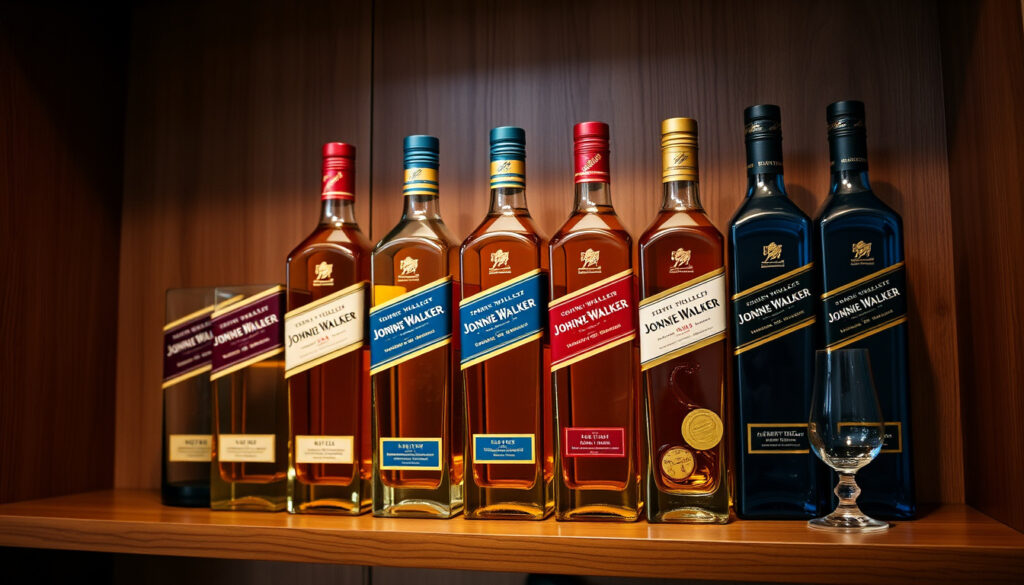
Johnnie Walker Levels: Complete Guide to Scotch Whisky Tiers
Few whisky brands pack as much recognition—and confusion—as Johnnie Walker, whose color-coded lineup from Red Label to Blue Label can feel like a puzzle. This guide breaks down each level, comparing age statements, prices, and flavor profiles so you can find the right bottle without the guesswork.
Founded: 1820 Wikipedia article ·
Origin: Scotland Wikipedia article ·
Owner: Diageo Wikipedia article ·
Core expressions: 6 The Whiskey Wash, whisky publication ·
Price range: $20 – $250+ The Whiskey Wash, whisky publication
Quick snapshot
- Johnnie Walker is a blended Scotch whisky (Wikipedia article)
- Produced in Scotland (Wikipedia article)
- Owned by Diageo (Wikipedia article)
- World’s best-selling Scotch whisky (Wikipedia article)
- Exact blend recipes are proprietary and not disclosed
- Specific whiskies in Blue Label blend are not publicly listed
- Green Label’s exact grain-to-malt ratio is not specified
- Double Black’s exact blend composition is proprietary
- Gold Reserve’s age statement is not given
- Founded in 1820 by John Walker in Kilmarnock, Scotland (Wikipedia article)
- Red Label launched in 1909, Black Label in 1909, Blue Label in 1992 (The Whiskey Wash, whisky publication)
- Consistently the world’s best-selling Scotch for decades (Wikipedia article)
- Blue Label remains the flagship premium expression (The Whiskey Wash, whisky publication)
- Limited-edition releases (e.g., Ghost & Rare) continue to expand the portfolio
- Growing demand for age-stated blends may influence future labeling
Here is a summary of key facts about Johnnie Walker.
| Attribute | Value |
|---|---|
| Founded | 1820 |
| Origin | Scotland |
| Owner | Diageo |
| Core expressions | 6 |
| Top-selling | World’s best-selling Scotch whisky |
| Price range | $20 – $200+ |
Is Johnnie Walker Scotch or Irish?
Where is Johnnie Walker produced?
Johnnie Walker is a blended Scotch whisky, meaning it is distilled, aged, and bottled in Scotland. The brand is owned by Diageo, a British multinational beverage company. The whiskies are produced at Diageo’s facilities across Scotland, including the Cardhu distillery in Speyside and the Caol Ila distillery on Islay. (Diageo official site)
What defines a Scotch whisky?
To be called Scotch whisky, the spirit must be produced in Scotland, aged for at least three years in oak casks, and bottled at a minimum of 40% ABV. Johnnie Walker meets all these criteria. It is not an Irish whisky, which is produced in Ireland and typically triple-distilled for a smoother finish. (Scotch Whisky Association)
Johnnie Walker is unequivocally Scotch. Any confusion stems from the brand’s global reach and the similar-sounding “Walker” name used by some Irish producers.
The evidence is clear: Johnnie Walker is Scotch, not Irish.
What are the Johnnie Walker levels?
What are the color-coded tiers?
Johnnie Walker’s core lineup consists of six color-coded labels: Red, Black, Double Black, Green, Gold Reserve, and Blue. Each represents a different tier of quality, age, and price. The hierarchy is clear: Red is entry-level, Black is the mid-range benchmark, and Blue sits at the top.
What is the difference between Red and Black?
Red Label is a no-age-statement (NAS) blend, commonly used for mixing. It is described with bright citrus, apple, spice, and light smoke notes. Black Label, by contrast, is an age-stated blend with whiskies aged at least 12 years. It offers dried fruit, vanilla, toffee, spice, oak, and smoke. The price difference reflects this: Red Label typically retails for $20–$30, while Black Label sits around $30–$35. (The Whiskey Wash, whisky publication)
What is the age statement of each level?
- Red Label: No age statement (NAS) – historically associated with a nine-year reference, but no longer carries an age (Threshers).
- Black Label: Minimum 12 years.
- Double Black: NAS, but smokier than Black Label.
- Green Label: 15 years old – a blend of single malts.
- Gold Reserve: NAS, smooth and creamy.
- Blue Label: NAS, though reportedly uses very old component whiskies (Threshers).
The pattern shows that age statements are not consistent across the range, making Black Label the standout for age-statement seekers.
What is the best Johnnie Walker label?
Which Johnnie Walker is smoothest?
Gold Reserve and Blue Label are widely regarded as the smoothest expressions. Gold Reserve is noted for honey and oak notes, while Blue Label is described with hazelnut, dark chocolate, and deep smoke. (The Whiskey Wash, whisky publication)
Which is better, Red or Black?
Black Label is the better choice for sipping neat or on the rocks, thanks to its 12-year aging and balanced profile. Red Label is best for cocktails and mixed drinks. The difference in price ($10–$15) is easily justified by the quality leap.
What is the most premium label?
Blue Label is the flagship premium expression, priced between $180 and $250 per bottle. Some reseller sources report prices as low as $150 for 750 ml, but it consistently sits at the top of the range. (The Whiskey Wash, whisky publication; Liquor Laboratory)
Black Label is the sweet spot for most drinkers: it’s affordable, age-stated, and versatile. Blue Label is for special occasions and gifting, where the label matters as much as the liquid.
Ultimately, the best label depends on your budget and preference, but the brand offers clear tiers.
Is Johnnie Walker a top shelf whiskey?
What does ‘top shelf’ mean?
“Top shelf” usually refers to premium spirits that are priced higher and perceived as higher quality. Johnnie Walker as a brand spans both budget and luxury tiers. Red Label is not top shelf, but Blue Label unquestionably is.
Is Johnnie Walker considered luxury?
Blue Label is often marketed as a luxury product, with its rare whiskies, elegant packaging, and high price point. It competes with other ultra-premium Scotches like The Macallan and Dalmore.
Which Johnnie Walker is top shelf?
Only Blue Label consistently qualifies as top shelf. Green Label, Gold Reserve, and the limited editions also command premium pricing, but Blue Label is the flagship.
The implication: while Johnnie Walker spans budget to luxury, only Blue Label truly qualifies as top shelf.
Why is Johnnie Walker so expensive?
What makes Blue Label costly?
Blue Label uses rare whiskies from distilleries that are no longer in operation or produce limited quantities. The blending process is also more labor-intensive, and the packaging is premium. These factors, combined with brand prestige, push the price to $180–$250. (The Whiskey Wash, whisky publication)
Is the price justified by quality?
Opinions vary. Some critics argue that the price is driven more by marketing than by liquid quality. However, blind tastings often rank Blue Label highly for smoothness and complexity. The price is a reflection of scarcity and brand cachet.
How does pricing compare across levels?
U.S. retail prices per 750 ml bottle (approximate, based on multiple sources):
Three labels, one clear pattern: the price jumps dramatically between Black and Blue, with a 5x–6x multiplier.
| Label | Price range | Age statement | Flavor profile |
|---|---|---|---|
| Red Label | $20–$30 (The Whiskey Wash, whisky publication) | NAS | Citrus, apple, spice, light smoke |
| Black Label | $30–$35 (The Whiskey Wash, whisky publication) | 12 years | Dried fruit, vanilla, toffee, oak, smoke |
| Blue Label | $180–$250 (The Whiskey Wash, whisky publication; Liquor Laboratory reports $150–$180) | NAS | Hazelnut, dark chocolate, dried fruit, deep smoke |
The implication: if you value age statements, Black Label is the clear winner. If you want the smoothest possible blend and have the budget, Blue Label delivers.
Upsides
- Wide range of price points to suit any budget
- Consistent quality across the core lineup
- Black Label is an excellent value age-stated whisky
- Blue Label is a luxury gift standard
Downsides
- Most expressions are NAS, frustrating for age-statement purists
- Blue Label’s price-to-liquid ratio is debated
- Red Label is thin for neat sipping
- Limited information on exact blend compositions
Clarity: confirmed vs. unclear
Confirmed facts
- Johnnie Walker is a blended Scotch whisky produced in Scotland.
- Owned by Diageo.
- Red Label has no age statement.
- Black Label has a minimum age of 12 years.
- Blue Label is the premium flagship blend.
- World’s best-selling Scotch whisky.
What’s unclear
- Exact blend recipes are proprietary and not disclosed.
- Specific whiskies used in Blue Label are not publicly known.
- Green Label’s exact grain-to-malt ratio is not specified.
- Double Black’s exact blend composition is proprietary.
- Gold Reserve’s age statement is not given.
- Age of component whiskies in Blue Label is not officially stated.
Johnnie Walker is a brand of Scotch whisky produced by Diageo in Scotland.
— Wikipedia article
Johnnie Walker Red Label is positioned as the entry-level, most affordable core blend and is commonly used for mixing.
Johnnie Walker Blue Label is positioned as the flagship or premium top-tier core blend.
— The Whiskey Wash, whisky publication
For the casual drinker, Johnnie Walker’s range offers a clear ladder from mixer to luxury sipper. The pattern is simple: pay more for smoothness and prestige, but the best value per year of age is Black Label. The catch is that the brand’s most famous expression, Blue Label, commands a premium that is as much about rarity as it is about taste. For the budget-conscious buyer, the choice is clear: stick with Black Label, or invest in Blue Label for that special occasion where the bottle itself is part of the experience.
thewinestop.com, colorwithleo.com, thewhiskeywash.com, manofmany.com, thesmokingchair.com, lisasliquorbarn.com, hangoverprices.com, thebottledprices.com, eathealthy365.com, slideserve.com
Frequently asked questions
How should I drink Johnnie Walker?
Red Label is best in cocktails or with a mixer. Black Label and above can be enjoyed neat, on the rocks, or with a splash of water.
Is Johnnie Walker gluten-free?
Distilled spirits like Scotch whisky are generally considered gluten-free, but individuals with celiac disease should consult a doctor. The distillation process removes gluten proteins.
What is the alcohol content of Johnnie Walker?
All core expressions are bottled at 40% ABV (80 proof).
Can Johnnie Walker be aged further in a bottle?
No. Whisky stops aging once it is bottled. The age statement refers to the youngest whisky in the blend at the time of bottling.
What is the difference between Johnnie Walker and other Scotch blends?
Johnnie Walker is known for its consistent quality, wide availability, and tiered pricing. Other blends like Chivas Regal or Dewar’s have different flavor profiles and age statements.
Is Johnnie Walker suitable for mixing?
Red Label is the go-to for mixing, but Black Label also works well in high-end cocktails. Blue Label is generally reserved for sipping to preserve its complexity.
More related posts
 Best Rated Kids Lunch Boxes for School in Ireland
 Spider-Man: Beyond the Spider-Verse – Release, Delay & LGBTQ
 Men’s Fashion Trends – Key Styles Shaping 2025
 Bar Keepers Friend Ireland: Uses, Safety Tips & Where to Buy
 Merry Christmas Message: 50+ Best Wishes, Quotes & Greetings
 Furniture Outlet Dandenong: Location, Hours, Deals & Reviews
 Lauren Sánchez: Biography, Wedding, and Public Scrutiny
 Rakul Preet Singh: Age, Husband, Net Worth, Movies
