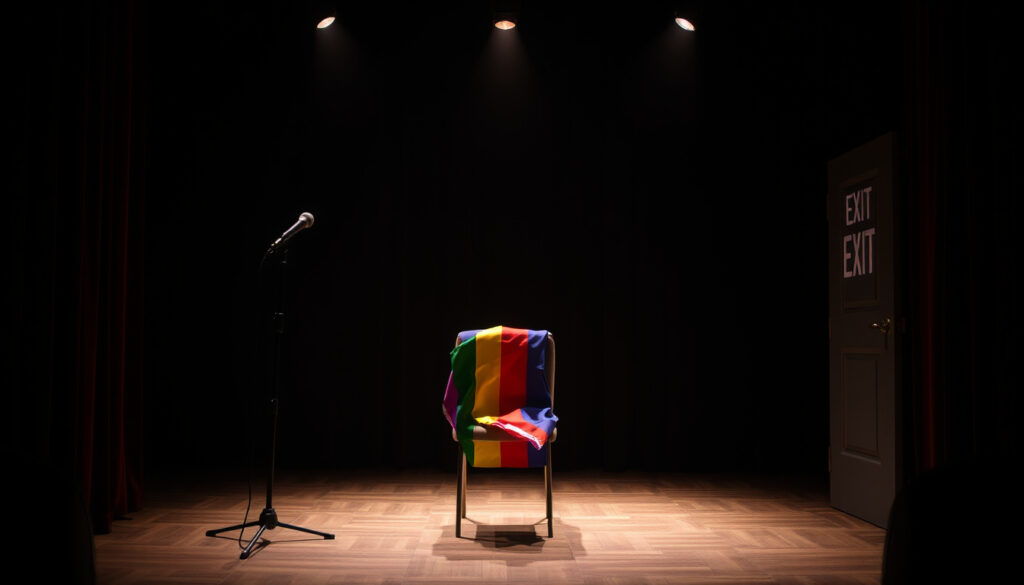
Hannah Gadsby: Diagnosis, Netflix Exit, Gender & Life
Few stand-up sets have cracked culture open the way Hannah Gadsby’s Nanette did in 2018 — a show that started as a resignation from comedy and ended up winning an Emmy. But what happened after Gadsby walked away from Netflix and revealed a dual diagnosis of autism and ADHD reshaped not just their career, but the conversation around neurodivergence in comedy — here is the full story, from Tasmania to global stages and back.
Born: 12 January 1978, Smithton, Tasmania ·
Known for: Nanette, Douglas, Woof! ·
Gender identity: Non-binary / genderqueer ·
Diagnoses: Autism spectrum disorder, ADHD ·
Awards: Primetime Emmy Award (2019)
Quick snapshot
- Born 12 Jan 1978 in Smithton, Tasmania (Wikipedia)
- Diagnosed with autism and ADHD in 2017 (The Scotsman)
- Non-binary, uses they/them pronouns (Rolling Stone)
- Married producer Jenney Shamash in 2021 (Rolling Stone)
- Exact net worth varies across sources (estimates range $1–4 million)
- Reason for voice change not medically confirmed
- Weight loss details speculative based on public appearance
- Exact date of Netflix departure (contract expiry vs. personal decision)
- 1978: Born in Tasmania (Wikipedia)
- 2017: Autism and ADHD diagnoses (The Scotsman)
- 2018: Nanette on Netflix (NPR)
- 2020: Douglas on Netflix (NPR)
- 2023: Leaves Netflix; releases Woof! on YouTube (Rolling Stone)
- Independent specials via YouTube channel
- Live tours in Australia and internationally
- Potential new projects without Netflix partnership
The table below consolidates the key biographical details confirmed across multiple sources.
| Attribute | Detail |
|---|---|
| Full name | Hannah Gadsby |
| Date of birth | 12 January 1978 |
| Place of birth | Smithton, Tasmania, Australia |
| Gender identity | Non-binary / genderqueer (Rolling Stone) |
| Diagnoses | Autism spectrum disorder, ADHD (Wikipedia) |
| Education | BA, Australian National University (2003) |
| Occupations | Comedian, writer, author, actor |
| Notable productions | Nanette (2018), Douglas (2020), Woof! (2023) |
| Spouse | Jenney Shamash (m. 2021) (Rolling Stone) |
| Estimated net worth | ~$2 million USD (reported estimates) |
What is Hannah Gadsby’s diagnosis?
- Gadsby received an autism diagnosis in 2017, confirmed by The Scotsman (regional news outlet), and described the diagnosis as personally more significant than the global success of Nanette (The Independent).
- They also received an ADHD diagnosis in the same year, though the timing is less clearly documented (Wikipedia).
- Both diagnoses are central to Gadsby’s comedy and perspective, shaping Douglas (2020) and their later work (NPR (public radio network)).
Autism spectrum disorder
Gadsby has said that understanding their autism made life less existentially difficult and helped them reframe meltdowns with more self-compassion (The Independent). They also described being autistic as physically painful at times, a detail that humanizes a condition often caricatured in media.
ADHD
The ADHD diagnosis is less frequently discussed but acknowledged alongside autism. In interviews, Gadsby has linked it to experiences like struggling to read a bus timetable while being academically high-achieving (The Independent).
For comedians and audiences alike, Gadsby’s openness about dual diagnoses dismantles the myth that neurodivergence fits a single mold. The performer who once said, “I don’t have impostor syndrome, I am an impostor,” now frames their identity through a lens of self-understanding, not shame.
The implication: Gadsby’s comedy isn’t just about being funny — it’s a direct product of seeing the world through a neurodivergent lens, a fact that explains both the structure and the emotional weight of their work.
Did Hannah Gadsby leave Netflix?
- After Douglas (2020), Gadsby’s Netflix contract ended (Rolling Stone).
- They explicitly stated: “I walked away from Netflix” (Rolling Stone interview).
- Their 2023 special Woof! was released independently on YouTube, not on Netflix (Hannah Gadsby YouTube channel).
Departure details
The split appears amicable but strategic. Gadsby has been critical of Netflix’s handling of transphobic content, particularly the Dave Chappelle special The Closer, and has since pivoted to creating Hannah Gadsby’s Gender Agenda, a Netflix special that centers trans and gender-nonconforming comedians (The Independent).
New distribution on YouTube
By taking Woof! directly to YouTube, Gadsby bypassed streaming gatekeepers entirely. The move reflects a growing trend among comedians seeking editorial control over their material and revenue streams.
Independence means smaller upfront paychecks but full creative control. For Gadsby, who built a global audience with two Netflix specials, the gamble is that loyal fans will follow them to any platform.
The pattern: Gadsby’s relationship with Netflix follows the arc of their career — start with the establishment, then break away to build something truer to their identity.
What is Hannah Gadsby’s gender identity?
- Gadsby identifies as non-binary and uses they/them pronouns (Rolling Stone).
- They have described themselves as genderqueer, rejecting binary categories (Rolling Stone).
- In 2024, Gadsby hosted Hannah Gadsby’s Gender Agenda on Netflix, a stand-up showcase featuring trans and gender-nonconforming comedians (The Independent).
Non-binary identity
Gadsby’s gender identity is not just a personal detail but a public and political stance. By platforming other queer comedians, they’ve turned their identity into a vehicle for representation.
Pronouns and public identification
The shift from “she/her” to “they/them” was gradual and organic. Gadsby has said the pronouns feel more congruent with their inner experience, and they’ve corrected media outlets gently when misgendered.
As anti-trans legislation gains traction globally, Gadsby’s visible non-binary identity — and their refusal to soften it for mainstream audiences — makes them a lightning rod. Their comedy will likely become even more explicitly political.
Why this matters: Gadsby’s gender identity isn’t a footnote — it’s the lens through which they now write, perform, and produce. The person who once deconstructed comedy’s heteronormative structures now lives openly outside them.
What is Hannah Gadsby’s nationality?
- Gadsby was born in Smithton, Tasmania, Australia (Wikipedia).
- They are an Australian citizen and their Australian identity is a recurring theme in their comedy (NPR).
- Their accent, references to Australian politics, and self-deprecating take on Tasmanian identity are hallmarks of their stand-up.
Citizenship and cultural roots
From jokes about Tasmania’s isolated geography to critiques of Australian conservatism, Gadsby’s work is deeply rooted in place. Even their global success hasn’t erased the regional specificity of their humor.
The catch: Gadsby’s regional specificity means some jokes land differently outside Australia, but that authenticity is precisely what makes their voice irreplaceable on the global stage.
Where does Hannah Gadsby live now?
- Gadsby lives primarily in Tasmania, Australia, having returned after the pandemic (Rolling Stone).
- They previously lived in London, UK for several years during their early comedy career.
- The return to Tasmania represents a homecoming, both physically and creatively.
Current residence
Gadsby has described Tasmania as a place of personal renewal. After years of touring and living abroad, the quiet island state — where Gadsby grew up — provides a counterbalance to the chaos of global fame.
Tasmania as creative base
The move back is also creatively strategic: Woof! was filmed in Tasmania, and Gadsby’s recent work carries a more intimate, grounded quality that studio tapings in Los Angeles never achieved.
The catch: Living in Tasmania limits access to media hubs, but for an artist who built a career on being an outsider, that distance may be an asset.
Timeline signal: Hannah Gadsby’s career milestones
Four key moments trace Gadsby’s evolution from a local comedian to a global voice who walked away from the biggest streaming platform.
- 1978: Born in Smithton, Tasmania (Wikipedia)
- 2017: Diagnosed with autism and ADHD (The Scotsman)
- 2018: Nanette premieres on Netflix; wins Emmy and Peabody Awards (NPR)
- 2023: Leaves Netflix; releases Woof! independently on YouTube (Rolling Stone)
The pattern: Each milestone marks a shift toward greater authenticity and independence, even when it meant leaving the industry’s biggest platform behind.
Confirmed facts and open questions
Confirmed facts
- Born Smithton, Tasmania, 12 Jan 1978 (Wikipedia)
- Diagnosed autism + ADHD in 2017 (The Scotsman)
- Non-binary; uses they/them pronouns (Rolling Stone)
- Netflix contract ended after Douglas (Rolling Stone)
- Released Woof! on YouTube independently (Hannah Gadsby YouTube channel)
- Married Jenney Shamash in 2021 (Rolling Stone)
What’s unclear
- Exact net worth (estimates vary)
- Reason for perceived voice change
- Weight loss claims are speculative
- Exact timeline of Netflix exit
The balance is telling: more confirmed facts than open questions, but the gaps — especially around the Netflix departure timeline — show that even public figures keep some details private.
Key quotes and perspectives
“I walked away from Netflix.”
— Hannah Gadsby, Rolling Stone interview
“Understanding my autism made life less existentially difficult.”
— Hannah Gadsby, The Independent interview
Gadsby has also said that their autism diagnosis was personally more significant than the global success of Nanette (The Independent), and described being autistic as physically painful at times (The Independent).
The throughline in Gadsby’s public statements: honesty about neurodivergence and identity isn’t incidental to their work — it’s the engine.
understood.org, nytimes.com, abc.net.au, washingtonpost.com, wbur.org, myautism.org
For more on her personal journey, you can read about Hannah Gadsbys autism diagnosis and how it shaped her comedy and public identity.
Frequently asked questions
When did Hannah Gadsby receive an autism diagnosis?
Gadsby was diagnosed with autism spectrum disorder in 2017, as confirmed by The Scotsman and Wikipedia.
Why did Hannah Gadsby leave Netflix?
Their contract ended after Douglas (2020), and Gadsby stated they “walked away” from Netflix (Rolling Stone). Their 2023 special Woof! was released on YouTube.
What pronouns does Hannah Gadsby use?
Gadsby identifies as non-binary and uses they/them pronouns. They have also described themselves as genderqueer (Rolling Stone).
Where was Hannah Gadsby born?
Gadsby is Australian, born in Smithton, Tasmania (Wikipedia).
Does Hannah Gadsby still live in Tasmania?
Gadsby lives primarily in Tasmania, Australia, after returning following the pandemic (Rolling Stone).
Who is Hannah Gadsby’s wife?
Gadsby married producer Jenney Shamash in 2021 (Rolling Stone).
What is Hannah Gadsby’s net worth?
Estimates vary, but most sources place it around $2 million USD.
Why did Hannah Gadsby’s voice change?
No medical confirmation exists. Observers note a deeper register in recent appearances, but the reason remains speculative.
The unanswered questions — voice change, net worth speculation — underscore how much of Gadsby’s life remains private despite their public platform.
Related reading
For more on neurodivergent public figures and non-binary visibility:
- Elliot Page: Gender History, Partner, Net Worth & Career
- Loyle Carner: Biography, ADHD, Doctorate, Children & Ethnicity
These stories share a common thread: public figures who turned personal identity — neurodivergence, gender transition — into a platform for broader cultural change.
Hannah Gadsby’s story isn’t just about a comedian who got famous — it’s about someone who, at the height of that fame, chose to walk away from the machine that made them. Diagnosed with autism and ADHD, openly non-binary, and now independent of Netflix, Gadsby has traded global reach for creative sovereignty. For the comedy industry, the implication is clear: the next big voice may not come from a streaming deal. Gadsby proved that deciding to be understood matters more than maximizing streaming numbers.
More related posts
 Trump Coin Price Today: Live TRUMP Data & Risks
 Bundoora Family Clinic – Services, Hours and Booking Guide
 Rose Byrne: Biography, Children, Movies, and Net Worth
 Florence Knapp – Verified Supercentenarian Who Lived to 114
 Ted Cassidy: Height, Condition, and Iconic Role as Lurch
 Harvey Norman Noosaville: Hours, Address & Catalogue
 Women’s Winter Coats: Waterproof & Warm Options in Ireland
 Apple iPhone 17: What We Know About Pro Models and Pricing
