Georgia O’Keeffe: Life, Art, and Lasting Legacy
Few artists have shaped their own legend quite like Georgia O’Keeffe. Born on a Wisconsin dairy farm in 1887, she became America’s most celebrated modernist painter, her flower close-ups selling for record prices and her desert landscapes defining the Southwest. But behind the petals and bones lay a carefully constructed public image—as deliberate as any brushstroke—that she defended fiercely against critics who wanted to read more into her work than she ever put there.
Born: November 15, 1887 · Died: March 6, 1986 (age 98) · Nationality: American · Known for: Modernist painting, flower close-ups, Southwestern landscapes · Career span: Seven decades (1910s–1980s) · Major museum: Georgia O’Keeffe Museum, Santa Fe, NM
Quick snapshot
- O’Keeffe was a major American modernist painter (Georgia O’Keeffe Museum biography).
- She married Alfred Stieglitz in 1924 (Wisconsin Women Making History).
- She had no children (O’Keeffe Museum timeline).
- Exact nature of her later relationship with Juan Hamilton. (O’Keeffe Museum timeline)
- Whether O’Keeffe intentionally used sexual symbolism in her flower paintings (O’Keeffe Museum timeline).
- 1915: Decisive turn to abstraction, charcoal series sent to New York (O’Keeffe Museum timeline).
- 1929: First summer in New Mexico—landscapes become her signature. (O’Keeffe Museum timeline)
- O’Keeffe’s legacy continues to break records: Jimson Weed/White Flower No. 1 sold for $44.4M in 2014, the highest for any female artist at auction (Sotheby’s auction results).
- The Georgia O’Keeffe Museum remains the definitive archive of her life and work. (Sotheby’s auction results)
The key facts below draw from the museum’s primary archives.
| Full name | Georgia Totto O’Keeffe |
| Birth | November 15, 1887, Sun Prairie, Wisconsin (Wikipedia) |
| Death | March 6, 1986, Santa Fe, New Mexico |
| Education | Art Institute of Chicago, Art Students League of New York (Georgia O’Keeffe Museum biography) |
| Spouse | Alfred Stieglitz (m. 1924–1946) |
| Notable work | Jimson Weed/White Flower No. 1 (1932) |
| Museum | Georgia O’Keeffe Museum, Santa Fe |
What is Georgia O’Keeffe best known for?
Flower close-ups and their interpretations
- O’Keeffe is best known for large-scale flower paintings such as Jimson Weed/White Flower No. 1 (Georgia O’Keeffe Museum biography). She insisted they were simply close observations: “Nobody sees a flower really; it is so small. We haven’t time, and to see takes time.” That quote, recorded in the museum’s archives, became her defense against Freudian readings that saw female genitalia in every petal (O’Keeffe Museum timeline).
- By the mid-1920s she was recognized as one of America’s most important and successful artists (Georgia O’Keeffe Museum biography).
O’Keeffe spent decades insisting her flowers were formal still lifes, not erotic symbols. Yet the market rewarded the controversy: Jimson Weed became the most expensive painting by a woman ever sold at auction.
Southwestern landscapes and abstraction
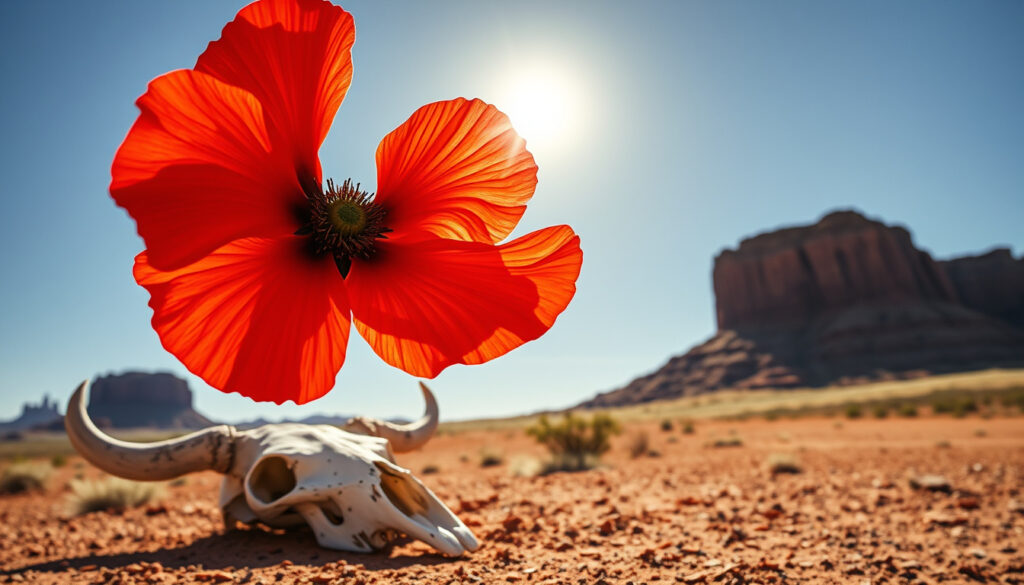
- After her first summer in New Mexico in 1929, her style shifted dramatically toward desert scenes, animal skulls, and adobe architecture (BYU Women’s History Month spotlight). She painted the Southwest until her death at 98.
Modernist legacy
- Alongside Arthur Dove and Marsden Hartley, O’Keeffe helped define American modernism. Her 1915 charcoal series marked a decisive break from representation (O’Keeffe Museum timeline). She was awarded the Presidential Medal of Freedom in 1977 (Georgia O’Keeffe biography).
The implication: O’Keeffe’s fame rests not only on her iconic subjects but on her ability to fuse radical abstraction with accessible, marketable images—a trick few modernists pulled off.
Why was Georgia O’Keeffe controversial?
Sexual interpretations of her flower paintings
- Freudian critics and journalists read her magnified blossoms as representations of female genitals. O’Keeffe denied these interpretations in interviews and letters. “I made you take time to look at what I saw,” she wrote, “and when you took time to really notice my flower you hung all your own associations with flowers on my flower” (Georgia O’Keeffe Museum biography).
Her relationship with Alfred Stieglitz
- Stieglitz, 23 years older and her eventual husband, promoted her work aggressively—and also photographed her nude. The 1921 Stieglitz retrospective at The Anderson Galleries created a sensation with nude photographs of O’Keeffe (O’Keeffe Museum timeline). Critics argued her artistic identity was subsumed by Stieglitz’s lens.
Gender and the art market
- O’Keeffe deliberately challenged a male-dominated art world. She was the first female artist to have a retrospective at the Museum of Modern Art (1946) (MoMA artist page). Still, her auction prices lagged behind male peers for decades—until the 2014 $44.4 million sale broke that barrier.
Why this matters: The controversy around O’Keeffe was never about her skill—it was about how a woman’s gaze was allowed to be seen. She refused to let the market or the critics define her content.
While O’Keeffe denied any erotic intention, the very persistence of the sexual reading boosted her market value. The art world wanted the controversy, and she could not fully escape it.
Who was Georgia O’Keeffe’s partner?
Alfred Stieglitz: photographer and gallerist
- Stieglitz exhibited O’Keeffe’s work at his pioneering gallery 291 in New York beginning in 1916 (Georgia O’Keeffe Museum biography). By 1918 he had convinced her to move to New York and paint full-time (Wisconsin Women Making History).
Their marriage and collaboration
- They married in 1924. Stieglitz promoted her work relentlessly, but O’Keeffe also acted as his curator and manager. The collaboration was both personal and professional until Stieglitz’s death in 1946.
Later companion Juan Hamilton
- After Stieglitz’s death, O’Keeffe developed a close relationship with potter Juan Hamilton, more than 50 years her junior. The exact nature (romantic or companionate) remains unclear from primary sources, though Hamilton became her manager in her final decades (O’Keeffe Museum timeline).
The pattern: O’Keeffe’s partnerships were always artistically symbiotic. She never played the role of “muse” passively—she directed her own image from the start.
What are 5 facts about Georgia O’Keeffe?
Early life and education
- Born the second of seven children on a farm near Sun Prairie, Wisconsin (Wisconsin Women Making History). She studied at the Art Institute of Chicago (1905–1906) and the Art Students League of New York (1907–1908), where she won the William Merritt Chase still-life prize (Georgia O’Keeffe Museum biography).
Career milestones
- First solo exhibition in 1917 at 291 gallery. In 1929 she spent her first summer in New Mexico, which became her permanent home after 1949 (BYU Women’s History Month spotlight).
Personal life
- Married Stieglitz in 1924; had no children. Described by contemporaries as private, determined, and sometimes aloof (Wisconsin Women Making History).
Later years and death
- She painted her last unassisted oil painting, The Beyond, in 1972 (Georgia O’Keeffe Museum biography). Died in Santa Fe on March 6, 1986, at age 98.
Posthumous recognition
- The Georgia O’Keeffe Museum opened in Santa Fe in 1997. In 2014, Jimson Weed/White Flower No. 1 sold for $44.4 million, setting a record for a female artist (Sotheby’s).
The takeaway: O’Keeffe’s life reads like a deliberate arc—from farm girl to the highest paid female artist ever. She managed every turn.
Was Georgia O’Keeffe a nice person?
Contemporaries’ accounts
- Those who knew her described a fiercely independent personality—private, sometimes blunt, but capable of deep loyalty. She maintained close friendships with artists Arthur Dove and Marsden Hartley (Georgia O’Keeffe Museum biography).
Her reputation for independence
- O’Keeffe valued solitude and self-reliance above social approval. She often retreated to her Abiquiú home, controlling access to her life and work.
Relationships with other artists
- She promoted younger artists and served as a mentor to potter Juan Hamilton. But she also famously clashed with photographers who tried to capture her without permission—she insisted on controlling her image.
The trade-off: O’Keeffe’s “aloofness” was a defensive strategy. In a male-dominated art world, niceness could be mistaken for weakness.
Timeline
- 1887 – Born in Sun Prairie, Wisconsin (Wikipedia).
- 1905–1906 – Studied at the Art Institute of Chicago (Georgia O’Keeffe Museum biography).
- 1907–1908 – Studied at the Art Students League, New York; won the Chase still-life prize.
- 1915 – Created her abstract charcoal series, a turning point (O’Keeffe Museum timeline).
- 1916 – First exhibition at Stieglitz’s 291 gallery.
- 1924 – Married Alfred Stieglitz (Wisconsin Women Making History).
- 1929 – First summer in New Mexico; landscapes shift toward the Southwest.
- 1946 – Stieglitz dies; O’Keeffe moves permanently to New Mexico.
- 1972 – Paints last unassisted oil, The Beyond (Georgia O’Keeffe Museum biography).
- 1977 – Awarded Presidential Medal of Freedom.
- 1986 – Dies in Santa Fe at age 98.
- 1997 – Georgia O’Keeffe Museum opens in Santa Fe.
What we know and what remains unclear
Confirmed facts
- O’Keeffe was a major American modernist painter.
- She married Alfred Stieglitz in 1924.
- She had no children.
- She moved to New Mexico after Stieglitz’s death.
- Her flower paintings were often interpreted as sexual imagery, which she denied.
What’s unclear
- The exact nature of her relationship with Juan Hamilton (companion or romantic partner).
- Whether she intentionally used sexual symbolism in her flower paintings.
Key quotes
“Nobody sees a flower really; it is so small. We haven’t time, and to see takes time.”
Georgia O’Keeffe, as recorded in the O’Keeffe Museum biography (Georgia O’Keeffe Museum biography)
“Finally, a woman on paper.”
Alfred Stieglitz, on first seeing O’Keeffe’s charcoal series, quoted in the museum timeline (O’Keeffe Museum timeline)
“I made you take time to look at what I saw and when you took time to really notice my flower you hung all your own associations with flowers on my flower.”
Georgia O’Keeffe, on the sexual reading of her work (Georgia O’Keeffe Museum biography)
O’Keeffe spent a lifetime insisting on her own narrative. The controversy, the celebrity, the record prices—none of it would have happened if she had played by the rules the art world set for women. For the modern collector or museum-goer, the choice is clear: engage with the flowers on her terms, or miss the point entirely.
Related reading: Georgia O’Keeffe: Biography and Timeline · Timeline – The Georgia O’Keeffe Museum
Frequently asked questions
What is Georgia O’Keeffe’s most famous painting?
Jimson Weed/White Flower No. 1 (1932) is her most recognized work and sold in 2014 for $44.4 million (Sotheby’s).
Where can I see Georgia O’Keeffe’s art?
The Georgia O’Keeffe Museum in Santa Fe holds the largest collection. Major works are also at the Metropolitan Museum of Art, MoMA, and the Art Institute of Chicago.
How did Georgia O’Keeffe influence modern art?
She bridged abstraction and representation, especially through her large-format flower paintings and Southwestern landscapes. Her success opened doors for women in the art market (Georgia O’Keeffe Museum biography).
What techniques did Georgia O’Keeffe use?
She used oil paint with a precise, layered technique, often diluting it for translucent effects. She focused on close crops and dramatic scaling to emphasize shape and color.
Did Georgia O’Keeffe paint only flowers?
No. She painted New York skyscrapers, desert landscapes, animal bones, and abstract compositions. Flowers were a major theme but not exclusive (Georgia O’Keeffe Museum biography).
What is the Georgia O’Keeffe Museum?
Founded in 1997 in Santa Fe, New Mexico, it is the only museum dedicated to the work of a single female artist in the United States (O’Keeffe Museum about page).
How much are Georgia O’Keeffe paintings worth?
Her works have sold from six figures to $44.4 million for Jimson Weed/White Flower No. 1. Prices depend on period, subject, and provenance.
More related posts
 Hannah Green: Age, Husband, Prize Money & Career Facts
 Best Ski Jacket for Men and Women: 2025 Buyer’s Guide
 Pharmacies Near Me: Find the Best Local Pharmacy in Ireland
 MacBook Pro M5 – Release Date Specs and Prices
 Noah Wyle: Biography, Net Worth, Family, and ER Rumors
 Danielle Marsh NewJeans Departure: Lawsuit and What’s Next
 Seann William Scott: Net Worth, Career & Current Projects
 Radius of a Circle: Formula, How to Find & Calculate
